
By Jong-Woo Han | April 2026
By Jong-Woo Han | April 2026
SummitSelect.org | AI & Aging | Honest Answers | Technology After 60
Start Here: The Short Answer
Most of what seniors hear about AI is wrong.
Not wrong in small ways. Wrong in ways that actively prevent capable, experienced people from using tools that would genuinely improve their lives. Wrong in ways that are believed deeply and repeated confidently — by family members, by news programs, by well-meaning friends — without much examination of whether they’re actually true.
I’m 71. I’ve spent the past three years using AI tools seriously — as a writer, a researcher, a patient navigating the healthcare system, and as someone who thinks carefully about what this technology actually means for people in the second half of life. I’ve also spent that time talking to hundreds of older adults who are navigating the same question: is this for me, and can I trust it?
What I’ve found is that the myths are doing more damage than the technology itself. People who would benefit significantly from these tools are staying away — not because of anything the tools actually do, but because of things they’ve been told the tools do that simply aren’t true.
This article names the biggest myths clearly and replaces each one with what’s actually true. Not enthusiastic marketing. Not fear-mongering in the other direction. Just the honest picture, from someone who is actually in the demographic these myths are about.
Introduction: Where These Myths Come From
Before getting into the myths themselves, I think it’s worth understanding where they originate — because they don’t come from nowhere, and most of them contain a grain of something real that got distorted into something false.
Some AI myths come from science fiction. Decades of movies and television have established a specific image of what artificial intelligence looks like — usually robotic, usually threatening, usually far more autonomous and intentional than any current AI system actually is. That imagery shapes how people hear the word “AI” before they’ve interacted with any actual AI tool.
Some myths come from legitimate concerns about the technology that get overstated into blanket prohibitions. Privacy concerns are real — but they don’t mean AI tools are universally dangerous to use. Accuracy limitations are real — but they don’t mean AI tools are useless for practical purposes.
Some myths come from people who genuinely care about older adults but who translate their own unfamiliarity with the technology into warnings that go further than the evidence supports.
And some myths come from the media’s tendency to cover the most dramatic version of any story — which produces both “AI will solve everything” headlines and “AI will destroy everything” headlines, with the accurate, nuanced middle largely absent from the coverage.
Understanding this helps. The myths aren’t malicious, and neither are the people who repeat them. They’re the predictable result of a complex new technology being filtered through existing fears and simplified through repeated transmission.
Let’s take them apart one at a time.

Myth One: “AI Is Too Complicated for Seniors”
This is the myth I encounter most often, and it’s the one that causes the most harm because it sounds protective when it’s actually limiting.
Here is what’s true: some AI tools are genuinely complex. AI systems used in software development, data science, machine learning engineering — these require significant technical knowledge to use effectively.
Here is what’s also true: the AI tools most relevant to daily life — ChatGPT, Claude, Google Gemini, Microsoft Copilot — are not those tools. They are conversational interfaces. You type what you want in plain language. They respond.
That’s it. That’s the complexity level.
My mother — who did not own a smartphone until she was 72 and who calls me when her email “disappears” — was able to have a useful conversation with ChatGPT within fifteen minutes of being shown how to access it. Not because AI is trivially simple. But because the conversational interface requires the one skill she has developed over eight decades: the ability to describe what she needs in plain language.
The myth of AI complexity for seniors is almost always based on a category error — applying the difficulty level of complex AI development tools to simple AI conversation tools, the way someone might say “driving a car is too complicated” while describing what it takes to design an engine.
What’s actually true: The AI tools most useful for seniors require no technical knowledge, no special vocabulary, and no prior technology experience. If you can send a text message, you have the manual dexterity. If you can describe what you need to another person, you have the communication skill. The barrier is lower than almost any other technology most older adults have successfully adopted.
Myth Two: “AI Will Replace Human Connection”
This one worries me more than most, not because it’s remotely accurate but because it touches on something genuinely important: the irreplaceable value of human relationship in the second half of life.
The concern I hear: if seniors start talking to AI, they’ll stop talking to people. The AI will become a substitute for real friendship, real family connection, real community.
This is a theory about human behavior that doesn’t hold up to observation.
People who use tools that help them accomplish things don’t generally stop wanting human connection. Someone who uses a telephone to call a grandchild is not substituting the phone for the grandchild. Someone who uses a word processor to write a letter is not substituting the word processor for the relationship the letter maintains.
AI tools are, at their most useful, productivity enhancers for the activities that support human connection — not replacements for the connection itself. A grandfather who uses AI to understand the video game his grandson is obsessed with is using AI to deepen a human relationship, not to avoid one.
There is a legitimate concern embedded in this myth: that people who are isolated might use AI conversation tools in ways that substitute for human connection they’re not getting elsewhere. This is worth monitoring. It’s not an argument against AI tools — it’s an argument for addressing the underlying isolation, which exists independently of AI.
What’s actually true: AI tools support human connection more often than they undermine it. They help people communicate more clearly, understand each other better, and maintain relationships across distance and difference. Human connection is irreplaceable for the specific reasons it’s irreplaceable — and none of those reasons are threatened by the existence of a helpful text-based tool.
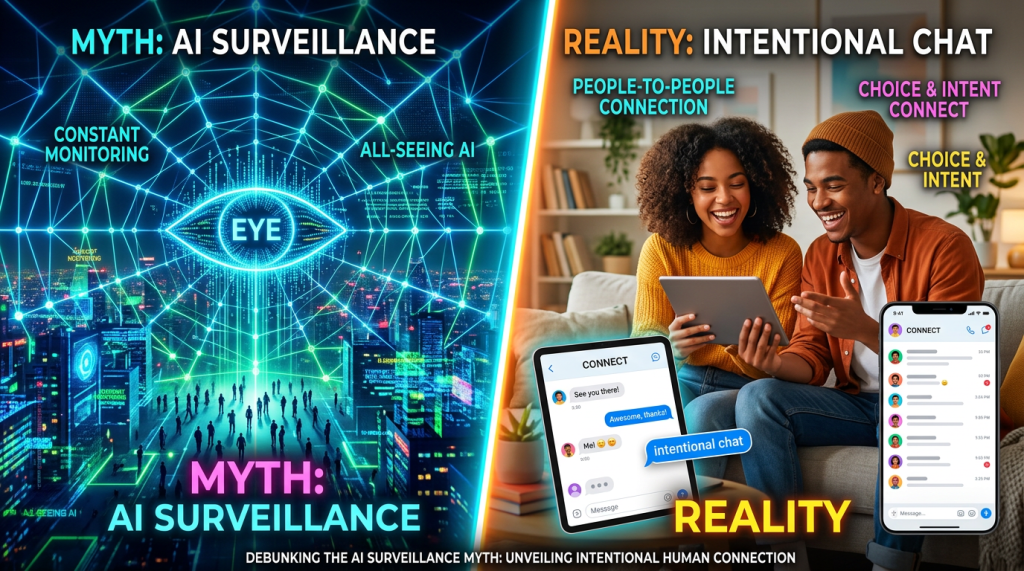
Myth Three: “AI Is Always Listening and Watching You”
This myth spreads so reliably because it feels consistent with legitimate privacy concerns — and because it conflates several different things into one frightening image.
Let me separate what’s actually true from what isn’t.
What’s true: Some AI-enabled devices are designed to listen for wake words. Amazon Echo devices and Google Home devices are activated by voice and do process audio. This is the legitimate basis for some privacy concern, and it’s reasonable to understand what you’ve agreed to when using these devices.
What’s not true: Conversational AI tools that you access through a web browser or app — ChatGPT, Claude, Gemini, and similar tools — are not listening to you through your device. They process only what you explicitly type or say into the tool’s interface. They are not monitoring your background conversations, your other applications, or your device activity.
The specific tools that I’ve recommended throughout my writing — the conversational AI assistants that help with writing, research, healthcare navigation, and daily tasks — operate only on what you deliberately give them. They’re not ambient surveillance tools. They’re on-demand conversation tools that exist only when you’re actively using them.
What’s also true: These tools do process the text you enter, and that text may be used to improve the AI system. This is a legitimate privacy consideration that I’ve addressed elsewhere — the appropriate response is to avoid sharing sensitive identifying information (Social Security numbers, financial account numbers, passwords), not to avoid the tools entirely.
What’s actually true: Conversational AI tools are not passively monitoring you. They operate only on what you actively provide during an intentional conversation. Understanding the actual scope of data processing — which is limited to what you deliberately type — is far more protective than avoiding the tools based on surveillance fears that don’t accurately describe how these tools work.
Myth Four: “AI Will Make You Dependent and Weaken Your Mind”
This one is particularly interesting because it’s sometimes framed as a concern for cognitive health — which makes it sound scientific when there’s actually no evidence supporting it.
The argument goes: if you use AI to write letters, look up information, and organize your thoughts, you’ll stop exercising those mental faculties and experience cognitive decline as a result.
This argument applies the “use it or lose it” principle to cognitive health — which is a real principle — but applies it incorrectly.
The “use it or lose it” principle in cognitive neuroscience refers to the value of mentally challenging activities for maintaining cognitive function. Reading complex material, learning new skills, engaging in novel problem-solving, having substantive conversations — these activities build what researchers call cognitive reserve.
Using AI to help write a formal letter is not exercising the same cognitive muscles as learning a new language. But using AI as a research tool, learning to use AI itself as a new skill, having substantive conversations with AI about complex topics — these are cognitively engaging activities. They’re not passive consumption.
More importantly: the alternative to using AI for many tasks is not always doing those tasks more cognitively — it’s often not doing them at all. A person who doesn’t write letters because writing is too time-consuming and frustrating is not maintaining their writing faculties. A person who uses AI assistance to write letters regularly is using language and maintaining social connections through communication.
What’s actually true: How you use AI determines its cognitive impact. Using AI to passively consume content without thinking is not cognitively stimulating. Using AI as a thinking partner — asking complex questions, evaluating responses, pushing for deeper explanation, applying what you learn — is cognitively engaging. The tool is neutral. How you use it determines the outcome.
Myth Five: “You’ll Accidentally Do Something Irreversible and Dangerous”
This myth manifests in a specific way: the fear of a single wrong click, wrong response, or wrong action that triggers some catastrophic and unrecoverable outcome.
I understand where this fear comes from. Early internet banking scares, email phishing that led to financial loss, complex software that produced expensive errors when misconfigured — these experiences have, reasonably, produced caution about technology.
But conversational AI tools don’t have this failure mode. There is no action within ChatGPT, Claude, or Gemini that has irreversible real-world consequences. You can ask a question. You can get a response. You can ask another question. Nothing you type into a conversational AI interface commits you to anything, charges you money, changes your accounts, or alters anything in the external world.
The worst that happens when you interact with an AI tool is that you get an unhelpful response. That’s it. You try again, with a different question. There is no mistake you can make in the course of a conversation that causes damage outside of that conversation.
The legitimate concern that sometimes underlies this myth is about acting on AI information without verification — making a consequential real-world decision based on AI output without appropriate checking. This is a real risk worth taking seriously. AI can be wrong. AI responses about medical situations, legal questions, and financial decisions should be starting points for further investigation, not final authorities.
But this concern is about decision-making after AI use, not about AI use itself causing harm. The appropriate response is to verify important information from reliable sources before acting on it — which is the same principle that applies to any information source.
What’s actually true: Conversational AI tools have no failure modes with real-world consequences. You cannot accidentally cause harm by asking a question or receiving a response. The relevant caution is about verifying important information before acting on it — which applies to all information sources, not specifically to AI.
Myth Six: “AI Is Only for Young People and Tech Experts”
This myth is perhaps the most culturally pervasive and the one most worth confronting directly.
It rests on a specific and false assumption: that the value AI provides is primarily in technical and creative applications that only younger, technologically fluent users benefit from. Code generation. Creative writing. Rapid prototyping. App development.
These are real use cases that some younger users find valuable. They’re not the primary use cases for which AI is most valuable in the second half of life.
The applications that provide the greatest daily value to adults over 60 are not technical. They’re practical. Understanding medical information. Writing difficult communications. Navigating complex systems. Researching decisions. Preparing for important conversations. Managing information that’s difficult to organize and retrieve.
These applications don’t require youth. They don’t require technical fluency. They benefit from exactly the qualities that older adults tend to have: the ability to ask specific, contextually informed questions; the patience to work through a conversation rather than expecting immediate perfect results; the judgment to evaluate AI responses critically based on real experience; and the clarity about what genuinely matters versus what’s merely impressive.
I’ve said elsewhere that older adults often make better AI users than younger ones — not in every context, but in the specific context of using AI for practical, high-stakes daily purposes. The patience, the specificity of their questions, the depth of the domain knowledge they bring to the interaction — these are advantages.
What’s actually true: AI’s most valuable applications for daily life don’t require technical expertise or cultural familiarity with technology. The qualities that make someone a good AI user — clear thinking, specific communication, domain knowledge, critical evaluation — tend to be stronger in older adults than in younger ones.
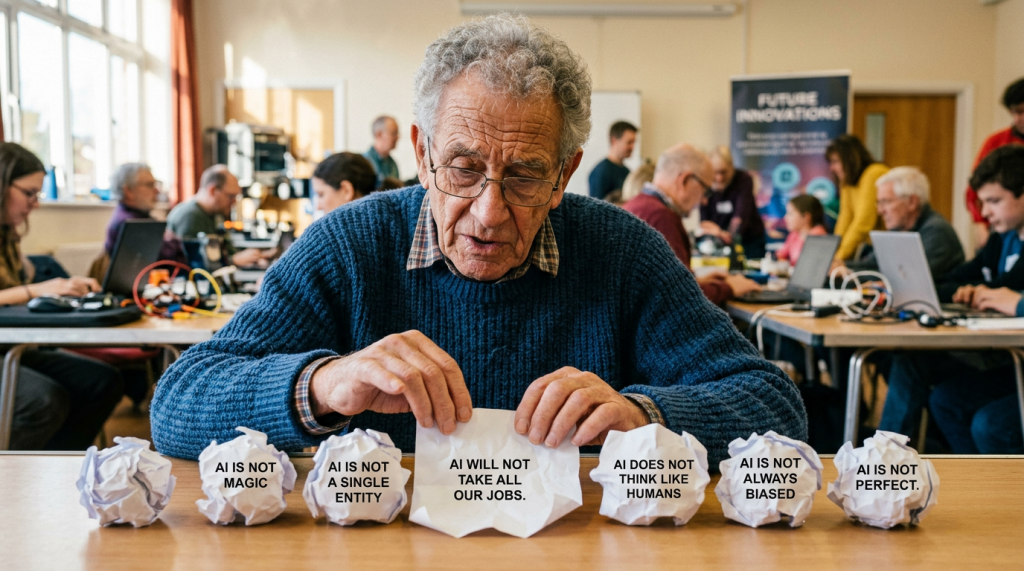
Myth Seven: “Everything AI Produces Is Unreliable”
This is the overcorrection myth — the one that swings too far in the direction of skepticism and ends up being as inaccurate as the uncritical acceptance it’s responding to.
It often starts from a real experience: someone asked an AI a factual question, received a confident-sounding but incorrect answer, and concluded that AI can’t be trusted for anything.
The error in this conclusion is applying a specific limitation to all uses indiscriminately.
AI tools do have genuine accuracy limitations. They can state incorrect information confidently. They can be out of date on recent events. They can make errors in specific technical calculations. These limitations are real and worth knowing.
But “sometimes wrong about specific facts” is not the same as “unreliable for all purposes.” And the specific applications where AI is most reliably valuable — organizing your thinking, drafting text for your review, explaining concepts in accessible language, generating questions you should be asking, helping you see a decision from multiple angles — are not applications where factual accuracy is the primary requirement.
A useful analogy: a calculator is unreliable if you misunderstand what it does (it processes the inputs you give it; if you give it wrong inputs, you get wrong outputs). But “calculators can give wrong answers if misused” doesn’t lead to “calculators are unreliable for all purposes.”
The right response to AI’s accuracy limitations is calibrated trust — using AI for the purposes where it’s reliable, verifying when accuracy matters, and maintaining appropriate skepticism for high-stakes factual claims. Not blanket rejection.
What’s actually true: AI tools are reliably useful for a significant range of applications — organizing thinking, drafting and editing, explaining concepts, exploring questions, preparing for conversations. For factual claims about medical, legal, financial, or scientific matters, verification through authoritative sources is appropriate. The limitation is specific and manageable; it doesn’t negate the genuine utility.
What to Actually Watch Out For
I don’t want to leave the impression that there are no legitimate concerns about AI. There are. They’re just different from the myths I’ve described.
Sophisticated scams using AI. AI is being used to generate highly convincing phishing emails, voice-cloned phone calls, and fraudulent communications. The appropriate response is vigilance about unexpected requests for money or personal information — regardless of how convincing the communication seems. This is a real and growing threat.
Sharing sensitive information inappropriately. Social Security numbers, financial account details, passwords — these should not go into AI conversations. You can describe your situation in general terms without providing specific identifying information.
Making consequential decisions based solely on AI output. AI is a starting point, not a final authority. Medical decisions, legal choices, financial moves — these warrant verification with qualified professionals before action.
Emotional over-reliance. For people who are significantly isolated, the availability of an always-responsive, apparently sympathetic AI conversation partner is worth thinking about carefully. The tool is not a substitute for human connection, and someone using it primarily to fill a social void they’re experiencing might be better served by addressing the isolation directly.
These are real concerns worth genuine attention. They’re also specific and manageable — not reasons to avoid AI tools entirely, but reasons to use them thoughtfully.

Frequently Asked Questions
Is it safe for seniors to use AI tools?
Yes, with specific precautions that apply to all online activity. Don’t share sensitive personal identifiers — Social Security numbers, financial account numbers, passwords — in AI conversations. Access AI tools through official websites or apps from established providers (OpenAI, Anthropic, Google, Microsoft). Be alert to scams that use AI-generated content — if you receive an unexpected urgent request for money or personal information, verify through a trusted channel before responding. Within these precautions, major AI tools from established providers are safe to use for daily practical purposes.
Does using AI mean your conversations are being recorded and watched?
Conversational AI tools process what you type into them — that’s how they respond to you. This text may be used to improve the AI system (something you can often opt out of in settings). They don’t activate your microphone, monitor your other applications, or surveil your home. Understanding this specific and limited scope is more accurate than either “completely private” or “completely surveilled.”
Will AI replace the need for doctors, lawyers, and financial advisors?
No. AI is useful for understanding information, preparing for professional appointments, researching options, and organizing your thinking. It is not a substitute for licensed professional judgment on consequential decisions. A useful analogy: medical information on the internet helps you understand your situation but doesn’t replace your physician. AI works similarly — it provides information and assists with thinking, but professional accountability and expertise remain essential for significant decisions.
Can AI tools be set up to be easier to use for seniors with vision or hearing challenges?
Yes. Most devices have accessibility settings that make AI tools more usable for people with vision challenges (larger text, higher contrast, screen reading) or hearing challenges (captions, text-based interaction). AI tools that operate through text are inherently accessible to people who find audio-based technology difficult, and voice-to-text input makes them accessible to people who find typing difficult. Accessibility settings on your device (phone, tablet, computer) are worth exploring before concluding a tool isn’t usable.
Is there an age at which learning to use AI tools is no longer worth it?
I can’t find evidence of such an age, and I’m suspicious of the question’s framing. The relevant factors are cognitive engagement, genuine daily need for the tool’s capabilities, and willingness to spend some time learning something new. These factors don’t have a universal age cutoff. I know people in their 80s who use AI tools for genuine daily value. I know people in their 60s who’ve decided they’re not interested. Individual circumstances matter far more than age.
What should I say to family members who tell me AI is dangerous and I shouldn’t use it?
Thank them for caring. Then distinguish between the specific, real concerns (don’t share sensitive personal identifiers; verify important health/legal/financial information; watch for scams) and the broader fear-based myths (AI is always watching, AI is too complicated, AI will replace human connection). The specific concerns are worth adopting as genuine practices. The broader myths are worth examining rather than accepting.
Summary
The biggest AI myths seniors should ignore are not random misinformation — they’re distortions of legitimate concerns, science fiction imagery, and well-intentioned but inaccurate protectiveness. Each one contains a grain of something real that’s been overstated into something false.
Myth: Too complicated. Reality: Conversational AI tools require no technical knowledge — just the ability to describe what you need in plain language.
Myth: Replaces human connection. Reality: AI tools support and enhance human connection more often than they undermine it.
Myth: Always listening and watching. Reality: Conversational AI operates only on what you deliberately provide — it’s not ambient surveillance.
Myth: Weakens your mind. Reality: How you use AI determines its cognitive impact. Used as a thinking partner, it’s cognitively engaging.
Myth: One wrong move causes irreversible harm. Reality: Conversational AI tools have no failure modes with real-world consequences from normal use.
Myth: Only for young people. Reality: AI’s most valuable practical applications favor qualities that older adults tend to have — clarity, patience, domain knowledge, critical judgment.
Myth: Everything AI produces is unreliable. Reality: AI has specific and manageable accuracy limitations; calibrated trust is appropriate, not blanket rejection.
The real concerns worth taking seriously: sophisticated AI-powered scams, appropriate information sharing, verification of consequential facts, and avoiding emotional over-reliance. These are specific and actionable — not reasons to avoid AI tools entirely.
Key Tips
1. Evaluate each claim about AI against your actual experience with the tools. Don’t accept myths or enthusiastic marketing. Try the tool. Form your own assessment.
2. Start with ChatGPT or Claude, free tier. The simplest path to testing whether the “too complicated” myth applies to you is to spend 20 minutes with either tool on a real task.
3. Never share Social Security numbers, financial account numbers, or passwords in AI conversations. This is the specific privacy protection that matters. General conversation about health, finances, and personal situations is fine.
4. Verify important factual claims from AI through authoritative sources. Medical information from your doctor. Legal information from an attorney. Financial information from a licensed advisor. AI is a starting point.
5. Distinguish between the specific, real concerns and the broad, inaccurate myths. Privacy has specific concerns worth adopting as practices. “AI is always watching” is not one of them.
6. Be vigilant about AI-powered scams — but direct that vigilance appropriately. Unexpected urgent requests for money or personal information — by phone, email, or text — warrant verification through trusted channels regardless of how convincing they sound.
7. Notice when a myth is functioning to protect someone from something they fear, rather than something that’s actually dangerous. This understanding makes it possible to address the underlying concern (usually “I feel overwhelmed by this new thing”) without accepting the inaccurate claim.
8. Use AI to understand AI. A useful early exercise: ask ChatGPT or Claude “What are the actual privacy limitations of using you?” and evaluate the response. It’s an instructive first conversation.
9. Tell family members specifically what you’re using AI for and what protections you’re taking. Concrete specificity often defuses myth-based concerns more effectively than abstract reassurance.
10. Give yourself permission to form your own view. You have decades of experience evaluating new things, including new technologies. Apply that experience here.
Conclusion
The myths about AI and seniors are costing people something real: the use of tools that would make their lives meaningfully better. Understanding about their own health conditions. Ability to communicate more effectively. Access to information that used to require expensive professional consultation. The capacity to share expertise they’ve spent a lifetime building.
None of that is trivially valuable. And none of it is inaccessible because of age.
The myths say otherwise. The experience of people who’ve actually tested the tools says something different.
I’m 71. I started from skepticism. I found genuine utility. The distance between “this isn’t for me” and “this actually helps” turned out to be about 20 minutes of honest experimentation — not the months of study the myths implied.
What you do with that information is your choice. But at least now you’re making that choice based on what’s actually true.
SEO Information
SEO Title:
The Biggest AI Myths Seniors Should Ignore — And What’s Actually True
Meta Description:
A 71-year-old author separates the biggest AI myths from reality for seniors — covering privacy, complexity, reliability, and human connection. Honest answers, no hype or fear.
Suggested URL Slug:
/ai-myths-seniors-should-ignore
Primary Keyword:
AI myths seniors
Secondary Keywords:
AI misconceptions older adults, is AI safe for seniors, AI and elderly, AI fears seniors, should seniors use AI, AI for older adults truth, common AI myths debunked
Search Intent:
People searching this term want honest, balanced information about whether common fears and concerns about AI are accurate — they’re skeptical of both AI hype and AI fear, and want someone experienced to give them the real picture.
Suggested Featured Image Prompt:
Warm, editorial-style photograph of a man in his early 70s at a kitchen table with a tablet or laptop, looking at it with a calm, evaluating expression — neither enthusiastic nor fearful. His expression conveys thoughtful assessment. A coffee cup nearby. Natural morning light. The mood is: someone who has done his research and formed his own honest view. Warm amber tones, shallow depth of field, editorial lifestyle photography.
Suggested Image Alt Text:
A 71-year-old man calmly evaluating AI tools at home, representing the honest assessment of AI myths that seniors should know about.
Internal Link Suggestions
1. Anchor Text: “why learning AI after 60 is a smart decision”
Suggested Content: A positive, experience-based case for AI learning in later life — the natural companion article to this myth-busting piece, providing the affirmative argument after debunking the negative myths.
2. Anchor Text: “protecting your personal data when using AI tools”
Suggested Content: A detailed guide to the specific, real privacy considerations for AI tool use — providing the actionable complement to this article’s myth-debunking on privacy.
3. Anchor Text: “how seniors can use AI safely online”
Suggested Content: A practical safety guide specifically for older adults using AI and internet tools — translating the “real concerns vs. myths” distinction in this article into specific protective practices.
4. Anchor Text: “10 best AI tools for seniors in 2026”
Suggested Content: A curated, honest guide to the specific tools most useful for older adults — the practical next step for readers who’ve had their myths addressed and want to know what to actually try.
5. Anchor Text: “using ChatGPT to simplify daily tasks after 60”
Suggested Content: A practical, task-specific guide to ChatGPT use for older adults — the entry-level “how to actually start” resource for readers who’ve finished this article and want to take their first step.
It’s never too late to learn, grow, and discover new possibilities.
Explore the books of Han Jong-Woo, where artificial intelligence, lifelong learning, personal growth, and meaningful living come together to inspire your next chapter.
Whether you’re curious about AI, seeking purpose, or simply looking for fresh inspiration, you’ll find books designed to encourage, empower, and enrich your life.
▶ Visit Han Jong-Woo’s Amazon Authorhttps://www.amazon.com/s?i=digital-text&rh=p_27%3AJongWoo%2BHan&s=relevancerank&text=JongWoo+Han&ref=dp_byline_sr_ebooks_1 Page and discover all of his books today.


Leave a Reply