By Jong-Woo Han | April 2026
SummitSelect.org | Second Career | Life After 60 | Career & Fear
The Answer You Need First
The fears are real. I want to say that clearly before anything else.
Not exaggerated. Not irrational. Not things you should simply push past with enough positive thinking. Real fears, with real roots, about real risks that deserve honest examination rather than cheerful dismissal.
But here’s what I’ve observed over years of watching people navigate the question of working after 60: the fears that stop people from taking action are rarely the ones that deserve to stop them. The fears that feel most powerful — “I’m too old,” “nobody will hire me,” “I’ll fail publicly” — are almost never the fears that turn out to be accurate predictors of outcome.
The fears that actually matter — the practical ones about Social Security timing, about the energy costs of full-time work at this age, about whether a particular type of work fits a particular person’s actual situation — get much less attention. They’re less emotionally vivid but more practically important.
I’m 71. I’ve navigated my own version of these fears. I’ve watched hundreds of people in my readership navigate theirs. This article names the biggest ones honestly, distinguishes the fears worth taking seriously from the ones worth setting aside, and offers something practical for each one.
Introduction: Why These Fears Deserve Serious Attention
Most advice about working after 60 takes one of two approaches.
The first is relentless positivity: your best years are ahead, experience is your superpower, age is just a number, go for it. This approach is encouraging and largely useless, because it doesn’t engage with the fears that are actually preventing people from moving.
The second is acknowledgment without guidance: yes, age discrimination exists, yes, there are real challenges, here’s a sympathetic list of them. This approach validates without helping — you finish reading feeling understood but no clearer on what to actually do.
What’s missing from both approaches is what I’ve tried to develop through years of writing about this: the ability to look at each specific fear directly and say, honestly, what’s true about it, what’s not true about it, what it’s actually pointing toward, and what to do given an accurate picture.
That’s what this article attempts.

Fear One: “I’m Too Old and Nobody Will Take Me Seriously”
This is the fear I hear first from almost everyone who brings up working after 60. And it’s the one with the most complicated truth embedded in it.
Here’s what’s true: age discrimination in hiring exists. It’s documented, it’s real, and it’s particularly prevalent in certain industries and certain types of hiring processes. If your strategy for working after 60 involves submitting online applications to large corporate employers in technology, media, or fast-growing consumer companies — you will encounter it, and it will be frustrating.
Here’s what’s also true: that specific strategy is not the only strategy, and it may not even be the best strategy for most people over 60 regardless of age discrimination.
The people I’ve watched successfully build meaningful work after 60 are, almost universally, not getting there through job boards and corporate application processes. They’re getting there through the professional networks they’ve spent decades building. Through direct outreach to organizations where they have existing credibility. Through consulting arrangements that bypass hiring gatekeepers entirely. Through independent work where the client relationship is built on demonstrated expertise rather than a resume filtered by an applicant tracking system.
The fear of not being taken seriously because of age is largely a fear about being evaluated by strangers who don’t know your work. The practical solution is to focus your energy on contexts where you’re not a stranger — where your work is already known, where your reputation precedes you, where the question isn’t “is this person credible?” but “can this person take on more?”
That reframe doesn’t eliminate the fear. But it redirects the energy from a place where age discrimination is most active to a place where it’s least relevant.
What to do with this fear: Don’t fight the terrain where age discrimination is most concentrated. Build in the terrain where your existing credibility is most relevant — your professional network, your former clients, the organizations and communities where you’re already known.
Fear Two: “I Don’t Have the Energy I Used to Have”
This is the fear that gets dismissed most quickly by cheerful second-career advice — and it deserves more respect than that.
Energy does change after 60. Not in ways that prevent meaningful work. But in ways that make the structure and pace of work matter more than they did at 40.
The specific changes that most affect working capacity after 60: recovery time after intensive effort increases. The ability to sustain peak cognitive performance for 10 or 12 consecutive hours decreases. The physical toll of commuting, of environments with poor acoustics, of constant interruption, of schedule unpredictability — these cost more than they used to.
None of this means you can’t work. It means you need to work differently than you might have at 45.
The work arrangements that consistently work well for people over 60 share specific characteristics: defined hours rather than open-ended availability, meaningful control over schedule, work that draws on accumulated expertise rather than requiring sustained novelty, remote or low-commute arrangements, and projects with clear scope rather than perpetual ambiguity.
These aren’t concessions. They’re design specifications. The work that fits your actual energy profile at 65 doesn’t need to look like the work that drained you at 45. It can be structured from the beginning for sustainability rather than adapted reluctantly when you’re already exhausted.
What to do with this fear: Take it seriously as a design constraint rather than dismissing it as weakness. Design the work arrangement — the hours, the pace, the commute, the type of work — around your actual energy profile. The goal is work you can sustain for years, not work you can sprint through for months.
Fear Three: “I’ll Fail and Everyone Will See”
The fear of public failure carries particular weight after 60, and understanding why helps address it honestly.
Earlier in a career, failure is expected. You’re building something. Mistakes are part of the process. The social permission to fail is embedded in the “early career” framing.
At 65, the framing is different. You’re supposed to have figured things out by now. A failed business, a consulting practice that doesn’t take off, a new career direction that doesn’t work — these feel more like evidence of permanent inadequacy rather than normal entrepreneurial iteration.
This fear has a specific consequence: it makes people unwilling to start anything that might not work immediately. Which eliminates most of the good opportunities, since most good opportunities take time and iteration to work.
Here’s what actually happens when things don’t work out at this age, based on observation: the consequences are almost always less visible and less damaging than the fear suggests. Most “failures” in second career development happen quietly — a consulting engagement that doesn’t lead to more, a product that doesn’t sell, an approach that needs to be adjusted. They’re not public humiliations. They’re private course corrections.
The one exception worth noting: failure is more visible when you’ve announced something publicly before it’s working. The person who tells everyone they’re launching a business before they have a single client, then has to explain months later that it didn’t quite come together, does experience something uncomfortable.
The practical solution to this isn’t secrecy. It’s sequencing. Let the results do the announcing. Start quietly. Build your first client, make your first sale, establish your first success before the public announcement. The thing that makes failure visible is announcing before you’ve validated. Building before you announce makes the failure private and the success public.
What to do with this fear: Sequence deliberately. Build before you announce. Let the first evidence of success come before the public declaration of what you’re doing. This doesn’t eliminate the risk of failure — it eliminates the unnecessary visibility of the early, inevitable iteration.

Fear Four: “The Technology Has Passed Me By”
This fear comes up specifically in conversations about working after 60, and it’s worth distinguishing two very different things that people mean by it.
The first meaning: “I don’t know the specific tools that are standard in the industry now.” This is a legitimate and solvable problem. Specific tool knowledge — which software platform, which communication system, which industry-standard application — can be learned. It takes time and some humility about being a beginner, but it’s not fundamentally different from any other skill acquisition.
The second meaning: “The way work gets done has changed fundamentally in ways I don’t understand.” This is a more substantive concern, and it deserves honest engagement rather than reassurance.
Here’s what I’ve observed: the fundamentals of how valuable work gets done have not changed as much as the surface presentation suggests. Clear thinking, reliable delivery, honest communication, genuine expertise — these are still what produce value in professional contexts. The platforms change. The underlying work doesn’t.
The older adults I’ve watched successfully navigate technology change in working contexts do one specific thing: they distinguish between the tools that are genuinely necessary for their specific work context and the broader technological landscape that feels overwhelming. They learn what they actually need for the specific work they’re doing, without trying to master everything.
A consultant who does her work through video calls and shared documents doesn’t need to understand TikTok’s algorithm. A writer who produces content for specialized publications doesn’t need to know how to run social media advertising campaigns. The technology that matters is the technology your specific work requires — and that set is usually much smaller and more learnable than the full landscape implies.
What to do with this fear: Identify the specific technology that your specific type of work actually requires. Learn that, specifically, with help if needed. Don’t let the overwhelming breadth of technological change obscure the narrower, learnable set of tools your actual work needs.
Fear Five: “I’ll Mess Up My Social Security or Retirement Benefits”
This fear is different from the others on this list. It’s not primarily about self-concept or social perception. It’s about money, and it deserves careful, specific engagement rather than emotional encouragement.
The concern is legitimate: working while collecting Social Security before full retirement age does affect benefits. Specifically, if you collect Social Security before your full retirement age (currently 67 for people born after 1960) and earn above a certain threshold, your Social Security benefits are temporarily reduced.
Key facts worth knowing:
The earnings limit for 2026 (for people who have not yet reached full retirement age) is approximately $22,320. Earnings above this threshold result in $1 of benefits withheld for every $2 earned above the limit. This is not a permanent loss — the withheld benefits are recredited to your account once you reach full retirement age, in the form of higher monthly payments.
Once you reach full retirement age, there is no earnings limit. You can earn any amount without affecting your Social Security benefits.
The Medicare situation is different and simpler: Medicare eligibility begins at 65 regardless of work status, and working does not affect your Medicare eligibility or benefits.
Pension benefits vary significantly by plan — if you have a pension, check your specific plan terms, as some penalize working while collecting pension income and others do not.
The practical implication: if you’re not yet at full retirement age and collecting Social Security, working income above approximately $22,320 per year has a real financial impact on your current cash flow. The long-term impact (due to the benefit recrediting mechanism) is more complex and depends on your specific situation.
This is the fear that most benefits from a one-time, specific conversation with a financial advisor or the Social Security Administration directly. The variables are individual enough that general guidance is less useful than specific guidance tailored to your age, your earnings history, and your benefit timing.
What to do with this fear: Don’t guess and don’t avoid. Call the Social Security Administration or consult a financial advisor who specializes in retirement income. Get the specific numbers for your specific situation. The fear is legitimate; the solution is information.
Fear Six: “I Don’t Know What I Have to Offer Anymore”
This one is harder to address than the practical fears, because it’s fundamentally about identity rather than logistics.
It appears most often in people who spent their primary careers in organizational roles — where what they contributed was inseparable from the systems, the team, the institutional context that made their work possible. Remove the institutional context, and they’re genuinely uncertain what remains.
This uncertainty is real. And it points toward real work that needs to happen before a second career can take shape.
The work is the translation problem I’ve written about elsewhere: taking what you know and what you’ve done inside an organizational context and articulating it in terms of standalone value — the specific knowledge, the specific judgment, the specific capabilities that exist independently of any particular employer.
Here’s what I’ve observed consistently: people who go through this translation process almost always discover more than they expected. Not because they weren’t already aware of what they knew — but because articulating it in standalone terms makes visible what was always there but wasn’t separately named.
A hospital administrator of 25 years doesn’t just have “hospital administration experience.” She has specific expertise in managing physician-nursing team dynamics under crisis conditions. She has specific knowledge of which regulatory requirements have teeth and which are routinely navigated around. She has specific judgment about which cost-cutting measures actually reduce quality of care and which are paper savings. Each of those specific capabilities has standalone value — to smaller hospitals, to healthcare startups, to healthcare policy organizations — that existed inside her organizational role but wasn’t labeled separately.
The translation work — getting specific about what you actually know and can actually do, independently of the institutional context — is the antidote to this fear. Not motivational reassurance. The specific cognitive work of translating organizational experience into standalone value.
What to do with this fear: Sit down with a blank page and write out, as specifically as you can, the knowledge you have that someone outside your former organization couldn’t easily acquire. Not your job title. Not your years of experience. The specific things you know about how things actually work in your domain. That specificity is the beginning of the answer to what you have to offer.

Fear Seven: “What If I Try and It Doesn’t Work — Then What?”
The “then what” fear is the one that sits underneath many of the others. Even after addressing the specific fears, the underlying question remains: what’s the actual downside if this doesn’t work?
This fear benefits from being made explicit rather than left implicit. Let’s actually answer the question.
If you attempt a consulting practice and it doesn’t generate clients: you’ve spent several months of time and some money on networking and preparation. You have more clarity about what does and doesn’t work in your specific market. You return to considering other options with real information rather than speculation.
If you write an eBook and it doesn’t sell: you’ve produced something that articulates your expertise clearly. That articulation has value beyond sales — in consulting conversations, in professional presentations, in your own clarity about what you know. You’ve practiced a process that subsequent projects will be faster and better at.
If you take a part-time role that doesn’t fit: you’ve learned something specific about what you do and don’t want from work at this stage. That information has value for the next decision.
In almost every realistic failure scenario, what you lose is time, some money, and some pride — all recoverable. What you gain is real information about what works and what doesn’t for your specific situation, which has direct value for the next attempt.
The fear of “then what” is often implicitly imagining an irreversible catastrophic outcome — the complete loss of retirement security, the permanent damage to professional reputation, the final proof that you had nothing left to offer. These outcomes don’t map to the realistic failure scenarios available to most people making careful, limited-commitment attempts at second career work.
What to do with this fear: Answer the question explicitly. Write down the realistic worst case of your specific attempt. Not the catastrophic imagined worst case — the realistic one. Then evaluate whether that realistic worst case is actually tolerable. In most cases, it is.
The Fear Beneath the Fears
There’s one more thing worth naming, because I’ve come to believe it underlies many of the specific fears rather than being separate from them.
The deepest fear about working after 60 is often not really about work. It’s about relevance.
About whether you still matter in the ways that mattered to you. About whether the decades you spent building expertise and reputation and relationships added up to something that continues to have value. About whether the world has moved on and left you behind.
I don’t have a simple answer to that fear because it doesn’t have a simple answer. It has a real one, which is different.
The real answer is that relevance after 60 is not given — it’s chosen and built. It doesn’t automatically persist from the accumulated past, and it doesn’t automatically disappear either. It depends on what you do with what you have.
The people I’ve watched remain genuinely relevant after 60 — in the deep sense of the word, not the social performance version — are the people who directed their attention toward the places where their specific knowledge and experience address a genuine need. Not the loudest places, not the most prestigious places, not the places that would have impressed their 45-year-old selves. The places where something real is needed and they actually have something real to offer.
That’s available to almost everyone with a serious career behind them. Finding it requires honesty about what you actually have to offer and intentionality about where to offer it. But it doesn’t require unusual courage, extraordinary talent, or perfect timing.
It just requires starting.
Frequently Asked Questions
Does working after 60 really affect Social Security benefits?
Yes, but only under specific conditions. If you collect Social Security before your full retirement age (currently 67 for most people) and earn above approximately $22,320 in 2026, your benefits are temporarily reduced — $1 for every $2 earned above the limit. Importantly, these withheld benefits are recredited to your account at full retirement age, resulting in higher monthly payments going forward. Once you reach full retirement age, there is no earnings limit. Call the Social Security Administration or consult a financial advisor to understand the specific implications for your situation.
Is age discrimination as bad as people say for workers over 60?
In certain contexts, yes. Research consistently documents age discrimination in hiring, particularly in large corporate environments, technology companies, and fast-moving consumer industries. However, this discrimination is most concentrated in formal hiring processes that evaluate strangers based on credentials. It is much less present in contexts built on existing relationships, professional reputation, and demonstrated expertise. For people over 60, the most effective strategy is typically to build in contexts where age discrimination has the least leverage — professional networks, direct outreach, independent consulting — rather than to fight it in contexts where it’s most active.
How do I know if the fear I have is worth taking seriously or worth setting aside?
Ask whether the fear points to a genuine constraint on your situation or to a story about yourself and your value. “I don’t know the Social Security rules” points to a real constraint with a specific solution (get the information). “Nobody will take me seriously” is almost always a story that doesn’t survive contact with the specific professional contexts where your expertise is most recognized. Fear that points to actionable information-gathering is worth taking seriously. Fear that’s primarily about self-concept usually needs to be moved through rather than resolved before acting.
What types of work are most realistic and sustainable for people over 60?
Work that leverages specific accumulated expertise rather than requiring significant new learning. Work with defined scope and hours rather than open-ended availability. Remote or low-commute arrangements where possible. Work built on existing professional relationships rather than cold outreach to strangers. Part-time or project-based arrangements rather than full-time employment. These characteristics aren’t universal requirements — some people over 60 thrive in full-time roles. But they describe the arrangements most consistently reported as sustainable and satisfying.
How long should I expect it to take before working after 60 generates meaningful income?
For consulting and independent professional work: typically three to six months to the first significant client, six to twelve months to consistent meaningful income. For digital products and online income: longer initial runway, often twelve to eighteen months before meaningful recurring income. For part-time employment: timeline depends heavily on industry and network strength. These timelines assume consistent effort — not occasional experimentation. Plan for them explicitly rather than expecting earlier results.
What’s the most important thing to do before attempting any kind of work after 60?
Get specific about what you’re offering to whom and why they would pay for it. “I want to consult” is not specific enough. “I help small healthcare practices navigate Medicare billing compliance, drawing on 25 years of hospital administration experience, working primarily with practices with under 20 physicians that don’t have in-house compliance expertise” is specific. The specificity determines whether you can effectively communicate your value, whether potential clients can immediately recognize if they need you, and whether your outreach will produce responses. Vague offerings get vague responses. Specific offerings get yeses or clear nos — both of which are more useful than vague non-responses.
Summary
The fears about working after 60 are real and deserve honest engagement — not cheerful dismissal and not acceptance as permanent limitations.
The fear of not being taken seriously is partly true (age discrimination exists in specific contexts) and partly a story (it doesn’t exist in contexts built on existing relationships and demonstrated expertise). The strategy is to build where your existing credibility has leverage.
The fear about energy is pointing toward a real design constraint — work after 60 needs to be structured differently than work at 45. The solution is intentional design, not denial.
The fear of public failure is addressed by sequencing — building before announcing, letting results precede declarations.
The fear about technology is manageable by distinguishing what your specific work actually requires from the overwhelming breadth of what exists.
The fear about Social Security and benefits is legitimate and has a specific solution: get the actual numbers for your specific situation.
The fear about having something to offer is addressed by the translation work — getting specific about the standalone value of what you’ve accumulated.
The fear about “then what if it fails” is addressed by making the realistic worst case explicit and finding it’s almost always tolerable.
And beneath all of them: the fear about relevance. Which doesn’t have a simple answer, but has a real one — relevance after 60 is chosen and built, not automatically given or automatically lost.
Key Tips
1. Name each specific fear explicitly before deciding what to do with it. “I’m scared about working after 60” is too vague to act on. “I’m scared that nobody will pay me for consulting because I don’t have a recent track record” is specific enough to address.
2. Distinguish fears that point to actionable information from fears that are stories about your value. The first type needs information-gathering. The second type needs movement through it rather than resolution before moving.
3. Call the Social Security Administration before making any work decision. Get the specific numbers for your specific situation. The general rules are not sufficient for financial decisions of this magnitude.
4. Build in contexts where your existing credibility is relevant. Focus your energy on your professional network and former clients before spending time on job boards and cold outreach.
5. Design the work arrangement for sustainability, not for maximum income. Hours, pace, commute, schedule control — these matter more at 65 than they did at 45. Build them into the design from the beginning.
6. Start before you’re ready. The fears don’t go away with more preparation. They diminish with action. Build your first client or make your first sale before the fear is gone.
7. Sequence deliberately — build before you announce. This keeps the inevitable early iteration private and allows you to make your success public rather than your process.
8. Separate the technology you need for your specific work from the broader technological landscape. Learn what you actually need. Don’t feel obligated to understand what you don’t.
9. Do the translation work. Write down — specifically — the standalone value of what you’ve accumulated. This is the antidote to “I don’t know what I have to offer.”
10. Make the realistic worst case explicit. Write it down. Evaluate whether it’s actually intolerable. In most cases, it isn’t — and seeing that clearly is one of the most practically effective fear-management tools available.
Conclusion
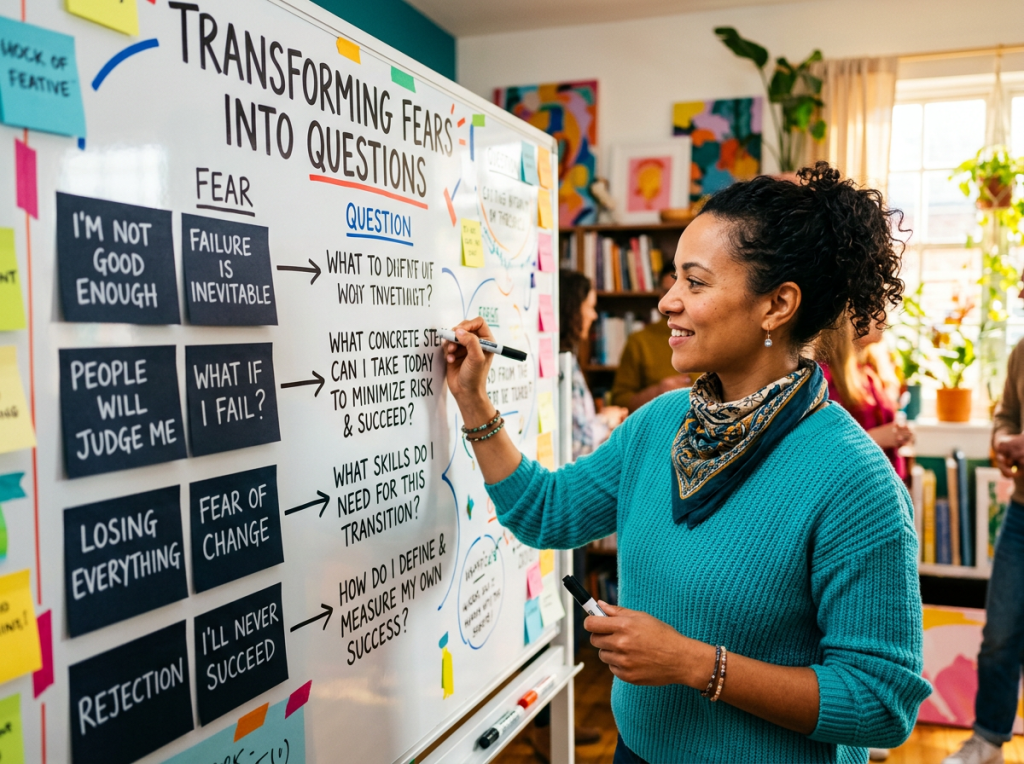
The fears about working after 60 are doing more damage than they need to. Not because they’re irrational — many of them point toward real things. But because they’re being treated as conclusions when they’re actually questions.
“Nobody will take me seriously” is a question: in which contexts, with which audiences, presenting myself in which ways? “I don’t have the energy” is a question: for what type of work, structured in what way? “I’ll fail and everyone will see” is a question: what specific attempt, with what realistic visibility?
Questions have answers. Conclusions end inquiry.
The people who work well after 60 — who build something meaningful with the experience they’ve accumulated — are almost never the people who weren’t afraid. They’re the people who turned the fears into questions and found, often to their surprise, that the answers were workable.
That option is available to you. It starts with naming the fears clearly enough to examine them honestly.
SEO Information
SEO Title:
Common Fears About Working After 60 — And What to Actually Do With Each One
Meta Description:
The fears about working after 60 are real but often misdirected. A 71-year-old author addresses each major fear honestly — what’s true, what isn’t, and what to do instead.
Suggested URL Slug:
/fears-about-working-after-60
Primary Keyword:
working after 60 fears
Secondary Keywords:
common fears second career after 60, afraid to work after retirement, age discrimination after 60, energy for working after 60, Social Security working after retirement, second career fears older adults
Search Intent:
People searching this term are actively considering some form of work after 60 and are held back by specific fears — they want honest engagement with those fears, not generic encouragement or dismissal.
Suggested Featured Image Prompt:
Warm, editorial-style photograph of a person in their early 60s sitting thoughtfully at a desk or kitchen table, looking forward with a calm, evaluating expression — not frozen by fear, not artificially confident, but genuinely considering. A notepad with written thoughts nearby. Natural light. The mood communicates honest reflection rather than either paralysis or forced positivity. Warm amber tones, editorial lifestyle photography, genuinely human.
Suggested Image Alt Text:
A person in their early 60s thoughtfully considering the common fears about working after 60, representing the honest examination this article provides.
Internal Link Suggestions
1. Anchor Text: “building confidence for a career change”
Suggested Content: A guide to the confidence-building process for career transitions — the natural companion to this fear-addressing article, providing the affirmative path forward.
2. Anchor Text: “advantages of starting a career later in life”
Suggested Content: A positive, evidence-based case for later career starts — providing the counterweight to the fears examined in this article.
3. Anchor Text: “how to prepare for a second career”
Suggested Content: A practical preparation guide — the action-oriented next step for readers who’ve worked through their fears and are ready to begin.
4. Anchor Text: “jobs that value life experience”
Suggested Content: A guide to the specific types of work where older adults have genuine competitive advantages — directly addressing the “nobody will take me seriously” fear with concrete alternatives.
5. Anchor Text: “work-life balance after 60”
Suggested Content: A guide to designing sustainable work arrangements in the second half of life — addressing the energy and sustainability fears with practical design principles.
Jong-Woo Han is a 71-year-old author and founder of SummitSelect.org. His books — including AI for Meaningful Living After 60 and The $1,000 AI Side Hustle — are available on Amazon.
Tags: Working After 60 | Second Career Fears | Career After Retirement | Age Discrimination | Working in Retirement 2026 | Second Career After 60
© 2026 SummitSelect.org — All Rights Reserved


Leave a Reply