
By Han Jong-woo | April 2026
SummitSelect.org | Retirement Finance | Economic Trends | Plain-English Money
The Bottom Line — Read This First
I am not a financial advisor. I want to say that clearly before anything else.
But I am a 71-year-old who has watched markets go up and crash and recover and crash again across five decades. I’ve seen oil prices send economies into recession and watched tech companies build fortunes overnight that disappeared almost as fast. And I’ve spent the last several months paying more attention than usual to what’s happening in both sectors — because what I’m seeing tells me something specific and practical about the financial landscape facing people in or near retirement.
Here is the short version.
Oil prices and tech stock valuations are not separate news stories for financial professionals. They are connected signals about the economy that directly affect your retirement account, your cost of living, your Social Security purchasing power, and the timeline of how long your money will last.
Most financial news is written for people who already understand the vocabulary. This article is written for people who don’t — and who need to understand the implications anyway, because their retirement security depends on it.
I’m going to explain what’s happening in plain language. What oil prices actually tell you about the economy. What tech stock volatility means for retirement portfolios. And what specific, practical steps are worth considering given the current picture.
That’s it. No jargon. No charts that require a finance degree to read. Just what you need to know and what to do with it.
Introduction: Why I Started Paying Attention Again
I’ll be honest about where this article came from.
Three months ago, I was filling my car with gas. The price per gallon had moved significantly — higher than it had been six months before, for reasons I didn’t quite understand. That same week, I opened my retirement account statement and noticed the tech-heavy portion of my portfolio had dropped meaningfully from the previous quarter.
Two things happening at once that felt vaguely connected but that I couldn’t quite explain to myself.
I’ve been managing my own financial life for fifty years. I have a basic grasp of how markets work. But the specific connection between what I was paying at the gas pump and what was happening to my retirement savings was something I couldn’t articulate clearly. And I’m a person who writes about complex topics for a living.
If I couldn’t explain it clearly to myself, I assumed other people my age probably couldn’t either. So I did what I do when I need to understand something: I read. I asked questions. I found the clearest explanations I could. And then I tried to write the article I needed three months ago.
What follows is what I learned.
[ILLUSTRATION PROMPT #1]
A warm, editorial-style illustration showing a man in his early 70s at a gas station, looking at the price display with a thoughtful expression — not alarmed, but clearly thinking. In the background, slightly out of focus, a smartphone screen shows a financial news headline about market movements. The visual connection between the gas price and the larger economic picture should be implicit — this is a person noticing that these things are connected and wanting to understand how. Warm amber afternoon light, editorial illustration style, completely ordinary and human.

Part One: What Oil Prices Actually Tell You — And Why Retirees Should Care
Oil Is Not Just About Gas
When most people think about oil prices, they think about gas prices. Understandably. That’s where we encounter the price directly, at a pump, in a number we can’t ignore.
But oil’s influence on the economy runs much deeper and wider than what you pay to fill your tank.
Oil is an input to the production of almost everything. The plastic in packaging. The fertilizer that grows food. The fuel that powers trucks that deliver goods to stores. The energy that heats homes and runs factories. When oil prices rise significantly, the cost of all of those things rises too — with a lag of weeks to months as the price increase works through the supply chain.
This is what economists mean when they talk about oil as an “inflationary force.” It doesn’t just make driving more expensive. It makes almost everything more expensive.
For retirees living on fixed income — Social Security, pension payments, distributions from retirement accounts — inflation is the specific financial risk that matters most. Your income doesn’t automatically grow when prices rise. Your savings lose purchasing power when inflation erodes it. The gas price increase I noticed at the pump three months ago was a signal about what was likely coming for grocery bills, utility costs, and a dozen other categories of expense within the following six months.
What’s Happening With Oil in 2026
Without going into the geopolitical detail that would fill a separate article, the current oil price environment reflects several overlapping pressures.
Supply is constrained relative to demand in ways that have been building for several years. OPEC production decisions have kept supply tighter than markets expected. Geopolitical instability in key producing regions has added uncertainty. And the transition toward renewable energy, while genuinely underway, has proceeded unevenly — reducing investment in new fossil fuel production without yet fully replacing its output.
The result is an oil price environment that is elevated and likely to remain volatile — meaning prices may swing significantly in either direction in response to news and events, rather than settling at a predictable level.
For retirement planning purposes, the practical implication is this: a sustained period of elevated oil prices means elevated inflation, which means your fixed income covers less than it used to. That’s a specific planning challenge that warrants specific responses — which I’ll cover toward the end of this article.
The Gas Price — Retirement Account Connection
Here’s the link I was trying to understand at the pump.
High oil prices raise costs across the economy. When costs rise faster than revenues, corporate profits fall. When corporate profits fall, stock prices tend to fall. When stock prices fall broadly, retirement accounts that hold stocks — which includes virtually every 401(k), IRA, and retirement portfolio — lose value.
Additionally, high oil prices increase inflation, which pressures central banks to raise interest rates. Higher interest rates make bonds more attractive relative to stocks, which pulls investment out of stocks and into bonds — further depressing stock prices.
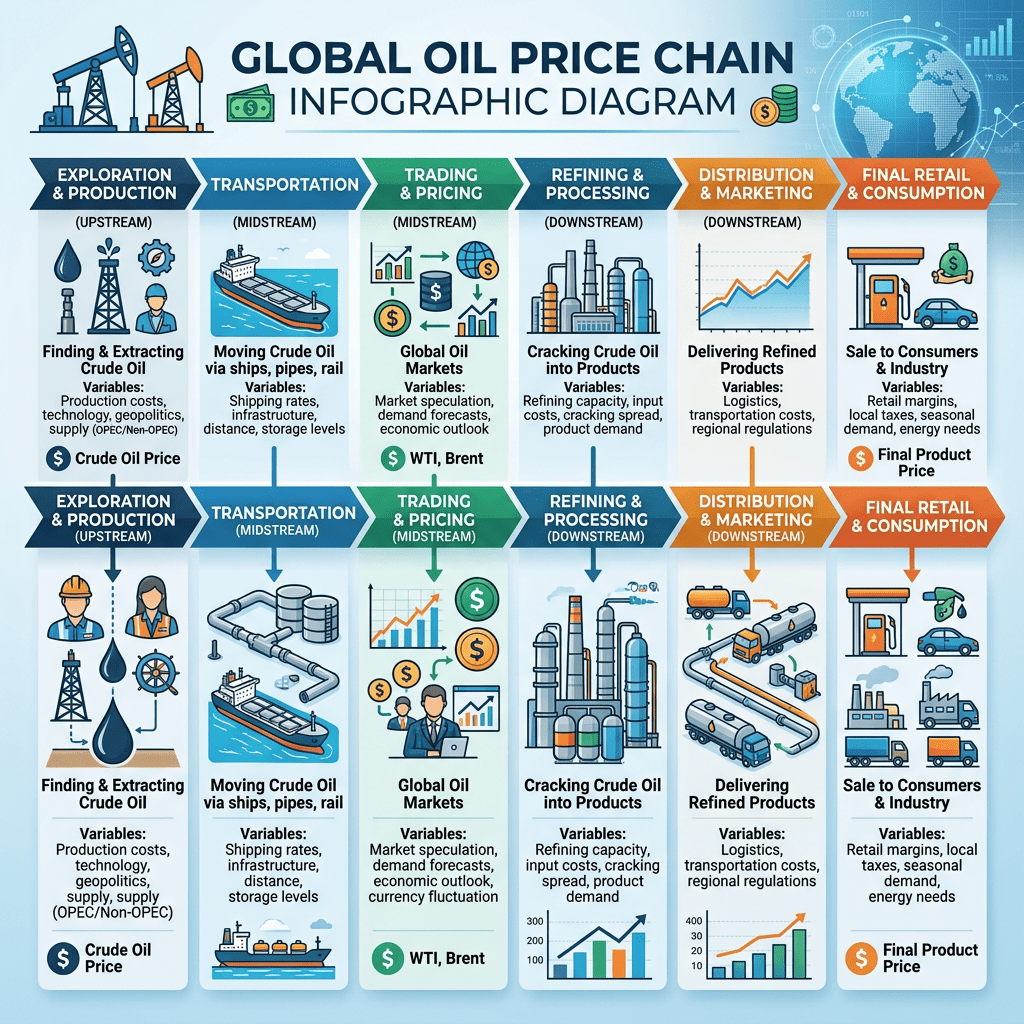
This chain of causation — higher oil → higher inflation → higher interest rates → lower stock prices → lower retirement account values — is not guaranteed to play out in any particular timeframe. Markets are complicated and other factors intervene. But it is a well-documented pattern that has repeated across multiple economic cycles. Understanding it means you’re reading the economic landscape rather than just reacting to it.
Part Two: What Tech Stock Volatility Means for Your Retirement
Why Tech Became So Central to Retirement Portfolios
If you hold a diversified retirement portfolio — a target-date fund, a balanced fund, or an index fund that tracks the S&P 500 — you are substantially invested in technology companies whether you know it or not.
The technology sector now represents approximately 30 to 35 percent of the S&P 500 by market capitalization. That means roughly a third of the value of the most common index that retirement portfolios track is in companies like Apple, Microsoft, Nvidia, Meta, Alphabet, and Amazon.
This concentration is higher than it has been at any point in the index’s history. And it has very specific implications for retirement investors.
When tech stocks do well — as they did dramatically between 2020 and late 2024 — broadly diversified retirement portfolios do very well. Many people nearing retirement watched their account values grow at rates that felt almost too good to be true.
When tech stocks fall — as they did in 2022, and as they have periodically since — broadly diversified portfolios fall more sharply than they would if the tech concentration were lower.
For someone in their 40s or 50s, this volatility is uncomfortable but manageable. Time is available for recovery.
For someone in or near retirement, it is a specific planning risk called sequence-of-returns risk — the danger that a significant market decline in the early years of retirement, combined with withdrawals to cover living expenses, can permanently impair a portfolio’s ability to recover.
[ILLUSTRATION PROMPT #2]
A clean, clear editorial illustration showing a simple diagram of the economic chain described in the article: an oil barrel → an upward arrow labeled “prices rise” → a factory/supply chain icon → a grocery store price tag → a retirement account icon showing a downward trend. The chain of causation should be visually clear and easy to follow without any prior economic knowledge. The design should feel like something from a quality financial magazine — clear, dignified, and honest rather than alarming. Warm teal and amber palette, clean editorial infographic style.
What’s Actually Happening With Tech in 2026
The technology sector in 2026 is experiencing something more complex than a simple up or down.
AI-related stocks — companies building the infrastructure for artificial intelligence, including chip manufacturers like Nvidia and cloud computing providers — have been extraordinarily valued, reflecting enormous expectations about the future revenue of AI technology.
Whether those expectations are accurate is genuinely uncertain. The technology is real and significant. Whether it will generate the specific revenues that current stock valuations assume, on the specific timeline that valuations assume, is a different question. Historically, transformative technologies have taken longer than initial investors expected to translate into broad profitability — and the stocks of companies riding transformative technology waves have experienced significant corrections when the initial enthusiasm encounters that reality.
This does not mean AI stocks are necessarily overvalued in any absolute sense. I’m not qualified to make that determination and neither is almost anyone outside of a very small group of analysts with specialized knowledge.
What it does mean is that the volatility we’ve seen in tech stocks — significant swings in either direction responding to quarterly earnings, to interest rate news, to geopolitical events — is likely to continue. And continued tech volatility means continued volatility in broadly diversified retirement portfolios with their current tech concentration.
The Specific Risk for People Near or In Retirement
I want to make this concrete.
Imagine someone who retired in January 2022 with $800,000 in a broadly diversified portfolio. In 2022, the S&P 500 fell approximately 19 percent. That portfolio fell to roughly $648,000.
If that retiree was withdrawing $40,000 per year to supplement their Social Security — a 5 percent withdrawal rate on the original portfolio, which is already on the aggressive side — they withdrew $40,000 from a portfolio now worth $648,000. That’s effectively a 6.2 percent withdrawal rate from the remaining balance.
The combination of market losses and continued withdrawals creates a compounding challenge that is very hard to recover from, because the base from which future growth compounds has been permanently reduced. This is sequence-of-returns risk. It is not hypothetical. It happened to real people who retired in 2022.
The tech concentration in today’s portfolios means that if a significant tech correction coincides with the early years of someone’s retirement, the magnitude of the impact is potentially larger than it would have been in a less concentrated era.
Part Three: What This Means for Your Retirement — Specifically
I’ve described two economic forces and their mechanisms. Now I want to be practical about what to actually do with this understanding.
I’ll say again clearly: I’m not a financial advisor. What follows is not personalized financial advice. It’s the framework I think about for my own situation, and the questions I’d bring to a qualified financial planner.
Question One: How Much of Your Retirement Portfolio Is in Equities — Particularly Tech?
Most people I talk to who are in or near retirement don’t know the answer to this with any precision. They know they have a “diversified” portfolio and they vaguely know it’s “mostly stocks” or “a mix of stocks and bonds.” The specific breakdown — and specifically the tech sector concentration — is worth knowing.
Look at your largest holdings. If you own target-date funds or S&P 500 index funds, you can find the sector breakdown on the fund provider’s website. Knowing that roughly 30 to 35 percent of your broad market index is technology tells you something important about your actual risk exposure.
Question Two: Is Your Withdrawal Rate Sustainable Given Current Conditions?
The traditional 4 percent rule was calculated based on historical market returns and inflation rates. It remains a useful baseline. But it was not calculated for an environment of elevated inflation combined with elevated tech stock valuations.
A simple stress test: if your portfolio fell 20 percent tomorrow — which has happened twice in the last fifteen years — and you continued withdrawing at your current rate, would your remaining portfolio realistically recover over the following decade? If the answer is uncomfortably uncertain, that’s worth discussing with a financial planner before a downturn rather than after.
Question Three: What Is Your Inflation Protection?
If oil prices remain elevated and drive sustained inflation, fixed-income sources — Social Security, pensions, bond income — purchase less than they did in lower-inflation environments.
Social Security has a cost-of-living adjustment (COLA), which provides some inflation protection, though the COLA calculation doesn’t always perfectly track the specific prices that older adults face (healthcare and housing, in particular, tend to inflate faster than the general index).
Treasury Inflation-Protected Securities (TIPS) are a specific investment class designed to maintain purchasing power in inflationary environments. If inflation is a genuine concern given your income structure, your financial planner can help evaluate whether TIPS have a place in your portfolio.
[ILLUSTRATION PROMPT #3]
A warm, practical editorial illustration showing an older couple — clearly in their late 60s or early 70s — sitting with a financial planner at a simple desk, all three looking at a document together. The couple’s expressions are engaged and thoughtful, not anxious. The financial planner is explaining something, pointing to a specific section of the document. The mood conveys the specific feeling of a genuinely useful professional consultation — not a sales pitch, but a real conversation among people who share a common goal. Warm natural light, editorial illustration style, human and professional.

Question Four: Are You Carrying Debt Into Retirement?
High interest rates — which tend to accompany the oil-price-inflation-rate-hike chain I described — make debt more expensive. Variable rate debt in particular — home equity lines of credit, adjustable-rate mortgages, some credit cards — can increase in cost significantly when interest rates rise.
Retiring with significant variable rate debt in a rising interest rate environment is a specific risk that is worth addressing directly. The priority order most financial planners recommend: pay off high-interest variable rate debt before entering retirement if at all possible.
What I’m Personally Doing With This Understanding
Since this is an experience-based article, I’ll be honest about my own situation.
I’ve reviewed my portfolio allocation with more attention than I gave it in the years when things were going well. I know that my broad index fund holdings have the tech concentration I described, and I’ve had a specific conversation with my financial planner about whether that concentration is appropriate given that I’m 71 and in the distribution phase of retirement.
I’ve also increased my attention to inflation-sensitive costs in my daily budget — utilities, groceries, healthcare — and I’ve adjusted my sense of what a “normal” monthly expenditure looks like upward from what it was two years ago. Not dramatically. But honestly.
And I’ve started thinking more carefully about the non-financial dimensions of financial security — specifically, the relationships and community ties that provide practical support when financial cushions get thinner. That might sound vague, but I mean it concretely: knowing that I have people I can ask for help, people whose homes I could stay in if I needed to, people who would tell me honestly if I were making a financial mistake — that’s a form of security that no portfolio allocation provides.
[ILLUSTRATION PROMPT #4]
A quiet, reflective editorial illustration showing a man in his early 70s at his kitchen table in the evening, looking at a simple financial statement with a calm, focused expression. On the table: the statement, a pen with some notes written in the margins, a cup of tea. Through the window, evening light. The mood is not anxious — it is the specific quality of someone taking their situation seriously and thinking clearly about it, without panic and without avoidance. Warm amber lamp light, editorial lifestyle illustration, dignified and genuinely human.

Summary and Key Takeaways
Oil prices and tech stock valuations are not abstract economic statistics that have nothing to do with your daily life. They are connected forces that directly affect your retirement account value, your cost of living, and the purchasing power of your fixed income over time.
Understanding the chain of causation — how oil prices drive inflation, how inflation drives interest rates, how interest rates affect stock valuations, how stock valuations affect your retirement portfolio — gives you a framework for reading economic news that is actually useful, rather than just anxiety-inducing.
The practical response is not to try to time markets or to make dramatic portfolio changes based on short-term economic signals. It is to know your actual exposure, stress-test your withdrawal plan, address inflation risk honestly, pay down variable rate debt, and have a genuine, specific conversation with a qualified financial planner about what you’re seeing.
The gas pump and the retirement account statement are connected. Understanding how means you’re a more informed steward of your own financial future.
10 Plain-English Tips for Navigating This Economic Moment
1. Know your actual portfolio allocation — not approximately, specifically. Log into your accounts. Find the sector breakdown of your largest holdings. Know what percentage of your retirement savings is in technology stocks.
2. Understand that oil price increases are inflation signals. When oil prices rise significantly, expect grocery prices, utility costs, and most other expenses to follow within months. Plan your budget around the likely reality, not the last normal period.
3. Review your withdrawal rate honestly. If you’re withdrawing 5 percent or more annually, run the stress test: what happens if your portfolio drops 20 percent in the next year? If the answer is uncomfortable, address it now rather than after.
4. Pay off variable rate debt before or early in retirement. Rising interest rates make this debt more expensive in ways that can significantly disrupt a retirement budget. Prioritize eliminating it.
5. Ask your financial planner specifically about sequence-of-returns risk. If they haven’t raised it with you, raise it yourself. It’s the specific risk that early-retirement market declines pose, and it’s worth explicit planning for.
6. Consider whether TIPS have a place in your portfolio. In sustained inflationary environments, Treasury Inflation-Protected Securities preserve purchasing power in ways that standard bonds don’t. Ask whether they’re appropriate for your situation.
7. Don’t try to time the market in response to economic news. The research on market timing is clear and discouraging for individual investors. The goal is appropriate allocation, not prediction.
8. Understand your Social Security COLA limitations. The annual cost-of-living adjustment helps but doesn’t perfectly track the inflation that older adults actually experience. Factor this into your long-term budget.
9. Review your spending in inflation-sensitive categories specifically. Healthcare, housing, and energy tend to inflate faster than general indices. Track these categories separately and adjust your budget accordingly.
10. Have a qualified, fee-only financial planner review your retirement plan in the current environment. Not a broker who earns commissions from what you buy. A fee-only advisor whose compensation doesn’t depend on what you invest in. One review, done well, is worth more than years of reading financial news.
Han Jong-woo is a 71-year-old author and founder of SummitSelect.org. This article is for informational and educational purposes only and does not constitute personalized financial advice. Consult a qualified financial professional before making investment decisions. All financial situations are individual and past market patterns do not guarantee future results.
Tags: Retirement Finance 2026 | Oil Prices and Retirement | Tech Stocks Retirement | Retirement Planning Seniors | Inflation and Retirement | Economic Trends Retirees | Plain English Finance
© 2026 SummitSelect.org — All Rights Reserved
It’s never too late to learn, grow, and discover new possibilities.
Explore the books of Han Jong-Woo, where artificial intelligence, lifelong learning, personal growth, and meaningful living come together to inspire your next chapter.
Whether you’re curious about AI, seeking purpose, or simply looking for fresh inspiration, you’ll find books designed to encourage, empower, and enrich your life.
▶ Visit JongWoo Han’s Amazon Author Page and discover all of his books today.
 Summit Select
Leave a comment