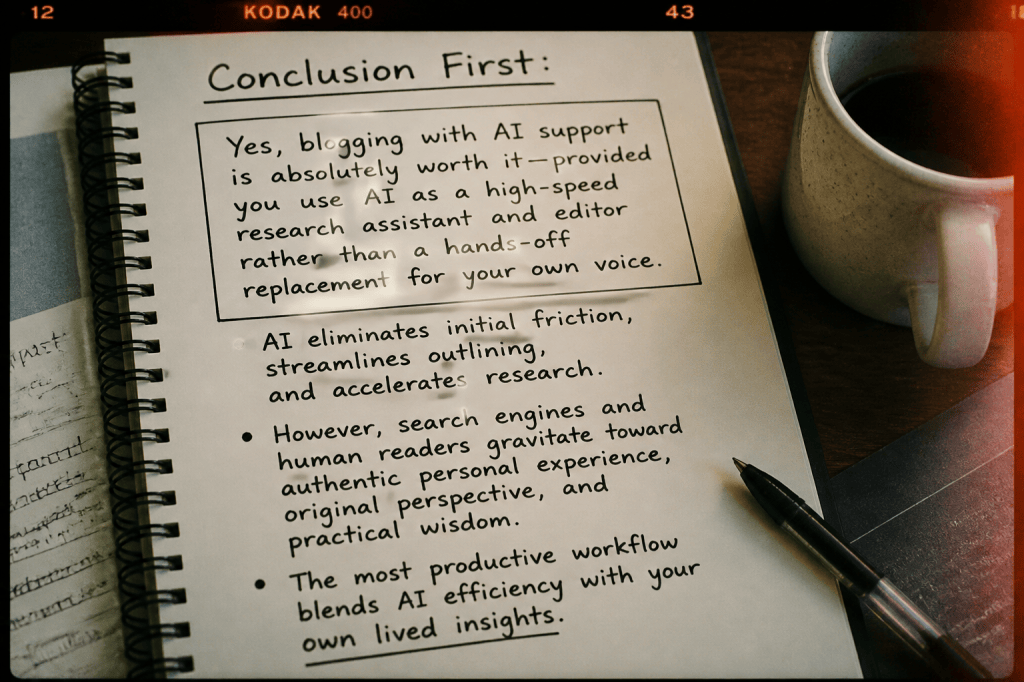
Conclusion First: Yes, blogging with AI support is absolutely worth it—provided you use AI as a high-speed research assistant and editor rather than a hands-off replacement for your own voice. AI eliminates initial friction, streamlines outlining, and accelerates research. However, search engines and human readers gravitate toward authentic personal experience, original perspective, and practical wisdom. The most productive workflow blends AI efficiency with your own lived insights.
My Journey with Digital Tools and Writing
When I first began working with personal computers decades ago, assembling desktop hardware piece by piece and learning system architectures, technology was a tool to extend human capability. It did not replace the person behind the desk; it amplified what they could do.
The rise of generative AI in content creation follows the exact same pattern. Over the years, as I have written online, published books, and managed digital projects, I have watched the blogging landscape shift dramatically. Many creators worry that AI-generated text will dilute the web with generic noise. Others hope they can press a button and let a machine run their entire platform.
Neither extreme works in practice. Drawing from my own daily experience testing workflows, publishing online, and organizing research across multiple platforms, I have found that AI is an invaluable asset when guided by a clear human mind. Here is my perspective on how to use AI thoughtfully, overcome daily blogging hurdles, and produce work that genuinely helps people.
The Modern Reality of Blogging
Why Long-Form Writing Still Matters
Despite the popularity of short-form video and fast-paced social platforms, written articles remain one of the most reliable ways to share structured knowledge. A social media post vanishes from view within days or hours. A well-constructed blog article continues to answer questions, guide readers, and build trust over many years.
Writing long-form content allows you to explore nuance, organize complex thoughts, and offer genuine solutions. Whether you write about technology, personal growth, health after 60, or creative endeavors, a blog serves as your central home on the internet.
The Struggles of the Independent Creator
Managing a blog independently is demanding. A writer is rarely just a writer; you are also the researcher, editor, strategist, and publisher. On any given day, you must:
- Select relevant topics that address real audience needs.
- Research facts, synthesize concepts, and outline logical sections.
- Draft, edit, and refine the prose for clarity.
- Manage formatting, images, and publishing schedules.
When done entirely manually, this process can lead to fatigue or inconsistency. This is where AI support enters as a practical collaborator.

How AI Acts as a Powerful Partner
Overcoming the Blank Page
The hardest part of writing is often starting. Sitting before an empty screen trying to craft the perfect opening paragraph drains unnecessary energy.
When facing writer’s block, I often use AI to generate five different structural outlines or brainstorm distinct angles on a single topic. I rarely use any of those suggestions verbatim, but reviewing options immediately breaks the mental barrier. It gives you a wall to bounce tennis balls against, helping you clarify what you actually want to say.
Streamlining the Research Process
Research routinely consumes more time than the actual drafting. Instead of opening dozens of browser tabs and sifting through dense articles, you can use AI to summarize core technical definitions, compare concepts, or highlight key points.
For example, if you are analyzing software configurations, digital tools, or historical context, AI can summarize the main frameworks within seconds. Your job is then to verify those details, apply critical thinking, and weave them into a clear narrative for your reader.
Polishing and Editing for Clarity
Even experienced writers benefit from an objective editor. AI excels at reviewing draft paragraphs to point out repetitive phrasing, overly long sentences, or unclear transitions. You can ask the system to suggest clearer sentence structures while explicitly instructing it to maintain your natural, conversational tone.

The Irreplaceable Human Touch
Personal Experience Cannot Be Simulated
AI synthesizes existing text from across the internet, meaning it delivers the average consensus on any given subject. It cannot share a personal story, describe a specific real-world lesson, or explain how it felt to overcome a frustrating technical problem.
Readers connect with authentic human experiences. When I share insights about learning computing in the 1990s, assembling hardware, teaching music, or adapting to new technology later in life, readers engage because those events are genuine. Your personal history, failures, and triumphs give your writing its true authority.
The Danger of Generic Content
If a blog relies entirely on unedited AI output, the content becomes bland, repetitive, and predictable. Readers spot generic prose instantly and click away.
Furthermore, search engine algorithms increasingly prioritize original insights, first-hand expertise, and practical utility. Content that simply repackages existing summaries without adding unique perspective offers very little value.
Fact-Checking Is Mandatory
AI language models generate text based on pattern recognition, not verified truth. They can occasionally state incorrect dates, misquote sources, or invent plausible-sounding details. As the publisher, full responsibility for accuracy rests with you. Every stat, technical instruction, and historical reference must be independently double-checked before publication.

A Practical Workflow for AI-Supported Blogging
To maintain high quality without burning out, adopt a structured, step-by-step workflow that keeps you in firm control of the output.
Step 1: Topic Selection and Ideation
Identify a real problem your readers face. Ask AI to generate related questions or subtopics people frequently search for around that issue. Select the items that match your expertise.
Step 2: Outlining the Framework
Use AI to construct a logical H2 and H3 heading structure. Review the outline carefully: add sections that reflect your personal insights, and delete generic or unnecessary headings.
Step 3: Drafting with Human Perspective
Draft the main sections yourself, or write detailed bullet points containing your personal experiences, anecdotes, and core arguments. Have AI polish the draft for readability, making sure to preserve your personal voice and examples.
Step 4: Editing, Fact-Checking, and Formatting
Read the draft aloud. Remove stiff phrases or artificial transitions. Verify every statement of fact. Ensure the article begins with a clear conclusion and uses short, readable paragraphs.

Frequently Asked Questions
Will search engines penalize blogs that use AI?
Search engines focus on content quality, accuracy, and value rather than whether an AI tool was involved in the process. However, low-quality, automated content generated without human oversight or original insight will perform poorly because it fails to satisfy human readers.
How much time can AI support actually save?
When integrated smoothly into your workflow, AI can reduce overall production time by 40% to 50%—primarily by accelerating research, topic planning, outlining, and initial proofreading.
What is the biggest mistake people make when blogging with AI?
The most common error is copying and pasting raw AI text directly onto a website without editing, adding personal stories, or verifying facts. This results in generic articles that fail to build a loyal readership.
How do I maintain my personal writing style while using AI?
Provide clear instructions to the AI tool. Explicitly tell it to write in a simple, conversational, and thoughtful manner. More importantly, always write your own introduction, personal anecdotes, and concluding thoughts yourself.
Can AI replace human expertise in specialized fields?
No. While AI can process vast amounts of published data, it lacks practical judgment, real-world experience, and deep domain wisdom. Specialized insights must always come from the human creator.
Summary
Blogging with AI support is a highly effective way to manage a digital publication, provided you retain full creative authority. AI handles repetitive tasks, structures content, and accelerates research, allowing you to focus on delivering meaningful ideas. The most successful blogs going forward will not be those written entirely by machines, nor those that ignore modern tools—they will be created by thoughtful writers who blend technology with authentic human experience.
Key Tips
- Use AI for Structure and Speed: Let AI generate outlines, refine drafts, and summarize research, but keep the final writing human.
- Anchor Content in Lived Experience: Share personal observations, practical examples, and genuine lessons learned in every article.
- Verify Everything: Double-check facts, dates, and technical steps independently before publishing.
- Prioritize Readability: Keep sentences clear, sections logical, and conclusions direct.
- Write for the Reader First: Focus on solving real problems for real people rather than trying to game search algorithms.
Conclusion
Technology has always evolved to make human expression more efficient, from the printing press to early personal computers and now generative AI. Using AI in your blogging journey is not about taking shortcuts or hiding behind an automated tool; it is about working smarter so you can share your knowledge more consistently. When you lead with genuine wisdom, clear structure, and personal authenticity, AI becomes the finest writing partner you could ask for.
Article Metadata & SEO Resources
- SEO Title: Blogging with AI Support: Is It Worth It? (A Honest Guide)
- Meta Description: Is blogging with AI support worth it? Discover a practical, human-first workflow that combines AI speed with personal experience for better content.
- URL Slug: blogging-with-ai-support-is-it-worth-it
- Primary Keyword: blogging with AI support
- Secondary Keywords: AI writing assistant, human-centered blogging, AI content creation workflow, blogging productivity, SEO blogging tips
- Featured Image Prompt: A thoughtful male writer in his early 70s sitting comfortably at a well-lit wooden desk with a laptop and coffee, reflecting with a smile as morning sunlight warms the room. Warm, authentic, photorealistic style, high resolution.
- Image Alt Text: Creator sitting at a laptop in a cozy home office reflecting on blogging with AI support.
- Internal Linking Suggestions:
- Link to: “How to Organize Digital Notes and Research Efficiently” (Anchor Text: organizing research workflows)
- Link to: “Essential Tools for Independent Digital Publishing” (Anchor Text: digital publishing tools)
- Link to: “Maintaining Authenticity in the Digital Age” (Anchor Text: authentic personal writing)
📘 Ready to Go Beyond This Article?
If you enjoyed this article, take the next step with my book:
ChatGPT for Seniors Premium Edition
A practical, easy-to-follow guide designed specifically for older adults who want to understand and use ChatGPT with confidence.
Inside you’ll learn how to:
✔ Use ChatGPT in everyday life
✔ Write emails, letters, and documents faster
✔ Learn new skills with AI
✔ Save time on daily tasks
✔ Communicate more confidently
✔ Explore the future of artificial intelligence—one step at a time
📖 Available Now
Gumroad Premium PDF Edition:
👉 [Insert Gumroad Link]
Thank you for reading, and I hope to see you inside the book!


Leave a Reply