By Han Jong-woo | April 2026
SummitSelect.org | Leadership & Life | Wisdom After 60 | Career Lessons
The Bottom Line — Read This First
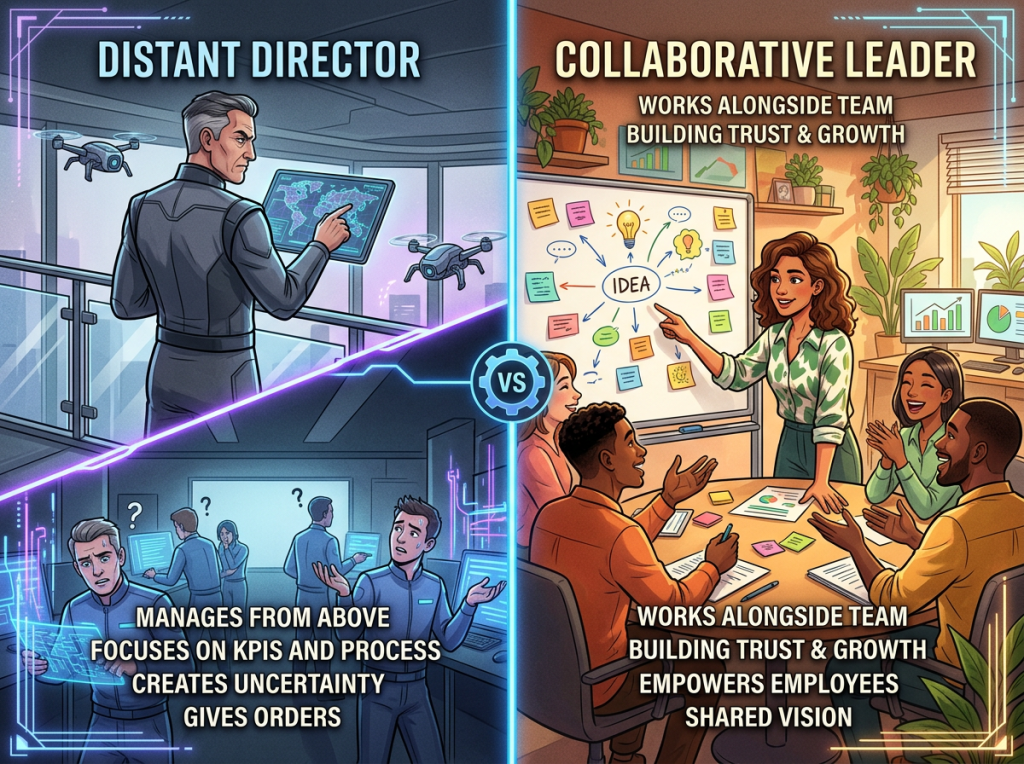
I worked under both kinds of people. And the difference wasn’t subtle.
One manager I had in my early 40s — I’ll call him Director Park — never once sat in on a meeting he’d assigned to us. He gave instructions from behind a closed door, received reports through an assistant, and appeared in the office mainly when something had gone wrong and someone needed to be held accountable. His team worked hard. Mostly from fear.
Another man I worked with a decade later — Mr. Kim, a division head who was technically two levels above me — had a habit that I still think about thirty years later. When a project was struggling, he would show up. Not to inspect. Not to assign blame. He would pull up a chair, roll up his sleeves, and say something like: “Okay, walk me through where we are. Let’s figure this out together.”
Same organization. Similar authority. Completely different experience of what it meant to work for someone.
One said “go.” The other said “let’s go.”
I’ve been thinking about that difference my entire adult life. This article is what I’ve figured out about it.
Introduction: Why This Distinction Matters More Than Ever
The phrase has been attributed to various people over the years. I’ve seen it credited to military generals, football coaches, and management consultants. I don’t know who said it first. I know it’s true — because I’ve lived both sides of it.
But I want to push beyond the inspirational-quote level of this idea and get into something more specific and more honest.
The boss-versus-leader distinction is not just about personality. It’s not simply that bosses are cold and leaders are warm. It’s about a fundamentally different theory of how human beings perform their best work — and about what a person in authority believes their actual job is.
Bosses believe their job is to direct and evaluate. Leaders believe their job is to create conditions in which other people can do their best work — and to demonstrate, through their own behavior, what that looks like.
That’s a different job description. It produces different outcomes. And it requires something that authority alone will never provide.
Let me tell you what I’ve learned about the difference from decades of watching it — and from the times I got it wrong myself.
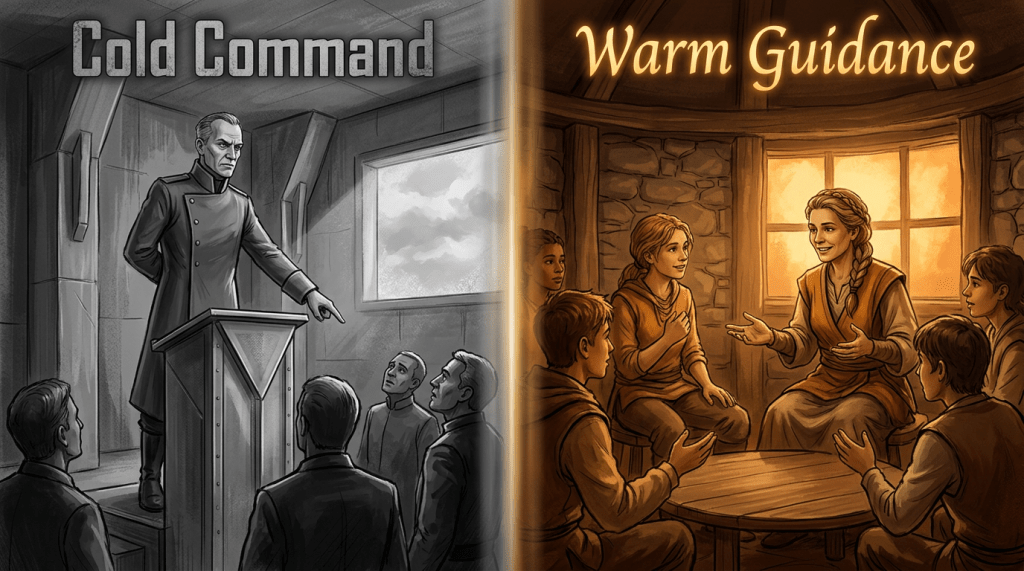
The Boss Mindset: What It Looks Like From the Inside
I want to be fair about this. Being a boss — in the directive sense — is often the result of how authority gets structured, not a character flaw.
Most organizations teach management through a model that emphasizes control. You set targets. You monitor performance. You reward compliance and address deviation. The tools of management — performance reviews, key performance indicators, organizational hierarchies — are all built around this model.
And this model produces results. Organizations run by bosses get things done. Deadlines get met. Processes get followed. In highly standardized environments — where the work is predictable and the people are interchangeable — the boss model works adequately.
What it doesn’t do well is unlock discretionary effort.
Discretionary effort is the difference between the minimum a person does to keep their job and the maximum they’re capable of when they genuinely care about the outcome. Research on organizational performance consistently shows that discretionary effort — not compliance, not minimum competency — is what separates good organizations from great ones.
And discretionary effort cannot be mandated. It cannot be extracted through fear or incentivized through bonuses alone. It is given voluntarily, by people who feel genuinely connected to the work and to the people they’re doing it with.
A boss can require the minimum. Only a leader can inspire the maximum.
What the Boss Model Does to People Over Time
I watched this happen in real time across my career.
Talented people in boss-led environments make a calculation, usually within the first year or two. They figure out the minimum acceptable performance — the floor below which there are consequences — and they perform just above it. Not because they’re lazy. Because they’ve learned, through experience, that extra effort isn’t recognized and that initiative is more likely to get you in trouble than rewarded.
This isn’t cynicism. It’s rational adaptation to an environment.
The tragic thing is that most of these people, in a different context, would give everything. They would stay late because they wanted to. They would solve problems that weren’t strictly their responsibility. They would care.
The boss model doesn’t lose their skills. It loses their hearts. And a person working without their heart in it is doing a fraction of what they’re actually capable of.
The Leader Mindset: What “Let’s Go” Actually Means
When Mr. Kim pulled up a chair during a struggling project, he wasn’t just being nice.
He was doing something specific. He was communicating, through action rather than words, that he considered the problem a shared problem — not my problem to solve while he evaluated from a distance. He was demonstrating that authority didn’t mean exemption from difficulty. And he was showing everyone in that room what it looks like to engage with a hard situation with curiosity rather than blame.
That behavior changed the energy in the room. I’ve never forgotten it.
“Let’s go” is not just more encouraging than “go.” It’s a fundamentally different statement about the relationship between the person with authority and the people they lead.
“Go” says: this is your responsibility, not mine. I will evaluate the results.
“Let’s go” says: this is our shared work. I have authority and I have accountability, but I’m in this with you.
The second model requires something the first doesn’t: genuine humility. The willingness to be seen in the middle of something difficult. The willingness to not have all the answers and to say so. The willingness to be changed by what you learn from the people you’re leading.
That vulnerability is not weakness. In my observation across decades, it is the single most powerful thing a person in authority can demonstrate.

The Specific Behaviors That Separate Them
I’ve spent a lot of time thinking about what, specifically, distinguishes leader behavior from boss behavior. Here’s what I’ve observed most consistently.
Leaders Solve Problems With People, Not For Them or To Them
A boss, encountering a struggling team, typically does one of two things. Either they step in and take over — removing the difficulty but also removing the learning and the ownership. Or they intensify the pressure — making the consequences of failure more vivid while doing nothing to address the actual obstacles.
A leader does something different. They sit down with the people who are struggling and ask: what’s actually in the way? What do you need that you don’t have? What have you tried that hasn’t worked?
This approach treats the people doing the work as the primary source of insight about the work. Which they are. The person closest to the problem usually understands it best. The leader’s job is to help them think through it — and to remove obstacles that are above their pay grade to address.
Leaders Absorb Pressure From Above Rather Than Transmitting It Downward
This is one of the behaviors I’ve observed most clearly — and one of the most differentiating.
Every organization has pressure. From markets, from customers, from boards, from regulatory environments. That pressure comes down through the hierarchy. What a leader does with it when it reaches them is crucial.
A boss transmits it. They pass the anxiety directly downward — making their team feel the full weight of external pressure as though it were organizational reality, using it to drive compliance through fear.
A leader absorbs it. They communicate honestly about the challenges the organization faces, but they filter the reactive anxiety and translate it into useful direction. They say: here’s the reality we’re dealing with, here’s what we need to do about it, here’s how I see us getting there. And then they stay calm, because their calmness is something the team desperately needs.
I saw this done well exactly once in my primary career, by a CEO during a genuinely difficult period. He gathered the senior team and told us, in clear terms, what the challenge was and how serious it was. And then he said something I’ve never forgotten: “My job right now is to make sure the weight of this doesn’t crush the people who are doing the work. That’s what I need all of us to do at our levels.”
That reframe — from “transmit pressure” to “absorb pressure on behalf of the people below you” — is one of the most precise descriptions of what leadership requires that I’ve encountered.
Leaders Credit Others and Own Mistakes
This sounds like a platitude. It isn’t. It’s one of the rarest behaviors in organizational life.
Most people in authority, when things go well, allow the credit to land at least partially on themselves. When things go wrong, they instinctively direct attention toward the people responsible for execution. This is almost universal, and understandable — it’s how incentive structures in organizations work, and human beings respond to incentive structures.
The leader who consistently reverses this — who is visible and effusive about the contributions of their team when things go well, and who is the first to say “I gave the wrong direction” or “I missed something” when things go wrong — creates something rare in organizational life: genuine psychological safety.
When people are not afraid of being blamed for honest mistakes, they take the risks that produce innovation. They tell the truth about problems before those problems become crises. They bring their best thinking rather than their safest thinking.
That environment — created and maintained by a leader who models accountability without blame-shifting — is worth more than any performance management system I’ve ever seen.
What This Looks Like in Life After a Career
I’m 71 now. My formal leadership years are mostly behind me, in the sense of organizational authority.
But I’ve come to believe that the distinction between boss and leader doesn’t retire when you do. It just shows up differently.
In families, the difference between a family elder who tells younger members what to do and judges the results, and one who walks alongside — asking questions, sharing hard-won experience without insisting on its application, trusting the next generation to find their own way — is enormous. I see the former produce distance and the latter produce genuine closeness.
In communities, the person who shows up and works alongside others — who doesn’t exempt themselves from the unglamorous parts of shared endeavor — creates something that the person who volunteers primarily to be seen and to direct never does.
In mentoring relationships, the mentor who says “let me tell you how I did it” and the mentor who says “let’s think through this together” produce dramatically different outcomes. One produces dependency; the other produces capability.
The leadership principle doesn’t require organizational authority. It requires the willingness to be in it with the people you’re trying to serve, rather than above them directing from a comfortable distance.
That’s available at any age, in any context, to any person willing to show up that way.

The Moments When It’s Hardest
I want to be honest about when this is genuinely difficult. Because pretending leadership is easy doesn’t help anyone.
It is hardest when you’re under real pressure and the temptation to simply direct — to use the authority you have to make the discomfort stop quickly — is genuinely strong.
I remember a period in my mid-50s when a project I was responsible for was seriously behind schedule, the client was asking hard questions, and I had three team members who were stuck and couldn’t seem to get unstuck. Every instinct I had was telling me to step in and take it over — to just do it myself and end the uncertainty.
I didn’t. With considerable effort, I sat down with the three people and spent two hours working through the problem with them.
It took longer than taking over would have. The solution they arrived at was better than what I would have produced alone. And those three people, from that point forward, had a capability they hadn’t had before — because they’d worked through a hard problem rather than watching it be solved for them.
That experience cost me two hours and some significant patience. It produced something that lasted.
The “let’s go” choice is frequently the harder one in the short term. It almost always produces better results in the long term.
The Leadership Failure I Still Think About
There’s one period I’m less proud of. Early in my management experience, under pressure from above and facing a team that was underperforming, I became more director than collaborator. More evaluator than partner. I used accountability as a weapon rather than a tool.
Two people left the team that year. One of them — a genuinely talented woman who needed development more than pressure — went on to do excellent work somewhere else. I’ve thought about that more than once.
I was a boss during that period, not a leader. The difference had real consequences for real people. I don’t say that to flagellate myself but because I think the honest acknowledgment of our own failures is more useful than the polished account of our successes.

What “Let’s Go” Requires of You
I want to close with something practical. Because the phrase is simple, but living it consistently is not.
“Let’s go” requires:
Genuine humility. You have to actually believe that the people you’re leading have knowledge you don’t. That they see things you can’t see from your position. That the direction of the work benefits from their experience, not just your authority.
Tolerance for slowness in the short term. Developing people — which is what leadership actually is — is slower than directing them. The results compound over time, but they require patience in the beginning.
The courage to be seen in the middle of difficulty. Not knowing the answer. Making a mistake in front of your team and owning it. Being genuinely uncertain about the path forward and saying so. These require a kind of courage that authority can actually make harder, because authority comes with the expectation of knowing.
Consistency in the moments when it’s hard. Anyone can be a collaborative leader when things are going well. The test is when the pressure is on and the temptation to revert to the boss model — to direct, to blame, to control — is strongest.
None of this is easy. All of it is learnable.
And the return — a team of people who give their best work because they genuinely want to, who bring problems forward early because they trust they’ll be met with collaboration rather than judgment, who stay and grow and develop capabilities that compound across years — is among the most valuable things a person in any position of authority can build.
Summary and Key Takeaways
The distinction between “go” and “let’s go” is not about personality style. It’s about two fundamentally different theories of what authority is for and how human beings perform their best work.
Bosses direct and evaluate. They get compliance. They get the minimum.
Leaders participate. They create conditions for other people’s best work, model what genuine engagement looks like, and stay in the difficulty alongside the people they lead. They get something that cannot be mandated: discretionary effort, genuine trust, and the compounding returns of people who grow because they were developed rather than merely directed.
The principle doesn’t retire when you leave organizational life. It shows up in families, communities, mentoring relationships, and any context where one person’s experience and position give them influence over others.
The “let’s go” choice is almost always harder in the moment and almost always better in the long run.
10 Key Leadership Principles Worth Remembering
1. Authority gets compliance. Leadership gets commitment. Know which one you actually need for the work in front of you — and choose the approach accordingly.
2. Sit down with people who are struggling before you evaluate them. You’ll learn more about the real obstacle, and they’ll learn more about what genuine leadership looks like.
3. Absorb pressure; don’t transmit it. The anxiety that comes down from above is yours to filter. Passing it directly downward unchanged is a failure of leadership, not a performance of accountability.
4. Credit others publicly and consistently. This is not generosity. It’s an accurate accounting of how work actually gets done — and it creates the conditions for people to bring their best thinking.
5. Own mistakes before someone else names them. The leader who says “I made the wrong call” first creates psychological safety. The leader who waits to be found out creates something else entirely.
6. Develop people, don’t just deploy them. Every interaction with someone you lead is either building or diminishing their capability. This is not a side responsibility — it is the primary job.
7. Be patient with slowness in the short term. The results of leadership compound. They are not visible in the first quarter. Give them the time they require.
8. Show up in the difficult moments. Your presence during the hard parts communicates something no speech or email can. It says: this is our shared work, and I’m not exempt from the difficulty.
9. Stay curious about what your people know that you don’t. The person closest to the problem usually understands it best. Your job is to ask good questions and remove obstacles — not to have all the answers.
10. Apply “let’s go” beyond organizational life. The principle doesn’t require a title. It works in families, communities, friendships, and mentoring relationships. Everywhere that influence exists, the choice between directing from above and walking alongside is available to you.
Han Jong-woo is a 71-year-old author, former executive, and founder of SummitSelect.org, where he writes about leadership, AI, and life after 60. His books are available on Amazon.
Tags: Leadership vs Management | Boss vs Leader | Leadership Lessons | What Makes a Great Leader | Leadership After 60 | Servant Leadership | Leadership Wisdom
© 2026 SummitSelect.org — All Rights Reserved
 Summit Select
Leave a comment