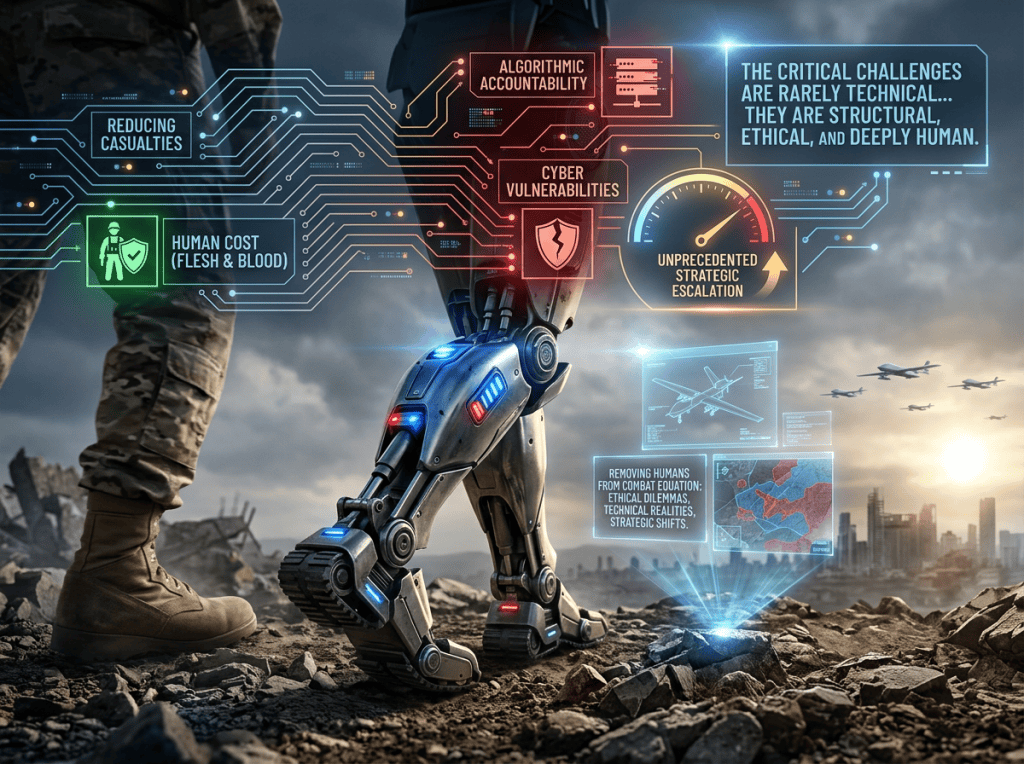
The short answer is clear: autonomous and remotely operated robots will fundamentally transform warfare and high-risk rescue operations, drastically reducing human casualties on the front lines. However, substituting software and steel for flesh and blood does not eliminate the cost of war—it shifts the burden entirely to algorithmic accountability, cyber vulnerabilities, and unprecedented strategic escalation.
As someone who has watched technological waves reshape industries—from the earliest desktop computers to today’s rapidly evolving AI systems—I’ve learned that whenever we automate a fundamental human activity, the most critical challenges are rarely technical. They are structural, ethical, and deeply human.
Below, we explore what happens when we remove humans from the combat equation, examining the ethical dilemmas, technical realties, and strategic shifts defining this new era.
The Ethical Dilemma: Responsibility in the Age of Autonomous Decisions
When a human soldier makes a fatal error on the battlefield, international law and military codes provide clear frameworks for accountability. But when an autonomous system misinterprets sensor data and targets non-combatants, the lines of responsibility blur instantly.
                  [ Autonomous System Action ]
                               │
       ┌───────────────────────┼───────────────────────┐
       ▼                       ▼                       ▼
[ Software Engineer ]    [ Field Commander ]    [ Procurement / State ]
 (Algorithmic Flaw)      (Deployment Rules)     (Policy & Liability)
1. The Accountability Vacuum
If a battlefield robot mistakenly attacks a civilian target, who takes the blame?
- The Software Engineer: Did the error stem from flawed training data or an unhandled edge case?
- The Military Commander: Was the system deployed in an environment too unpredictable for its software parameters?
- The Equipment Manufacturer: Did hardware latency prevent a timely abort command?
In practice, distributing responsibility across developers, commanders, and manufacturers creates an accountability vacuum where no single entity is held liable.
2. Dehumanization and the Threshold of Conflict
When nations no longer risk the lives of their own citizens on the ground, the political cost of entering a conflict drops significantly. Decisions that once required heavy deliberation, public consensus, and high political risk can become lower-friction operational choices. Removing human vulnerability lowers the barrier to entering a conflict.
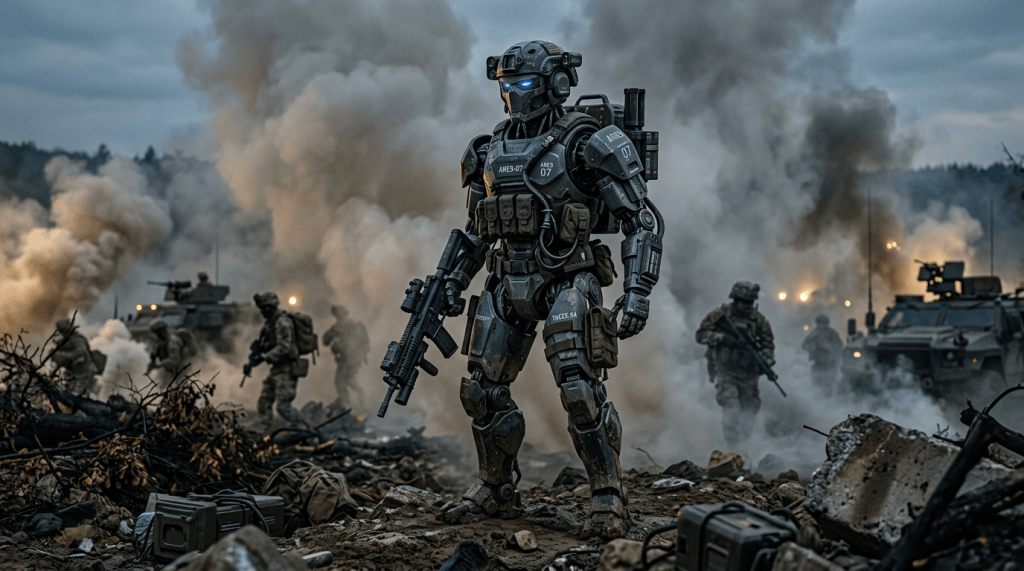
Technical Realities: Cost, Cyber Vulnerabilities, and Failure Modes
While sci-fi narratives depict invincible mechanical armies, the practical reality of maintaining complex hardware in harsh field conditions presents significant technical hurdles.
1. The Vulnerability of Connectivity and Code
Every autonomous or remotely operated machine relies on wireless signals, sensor arrays, and lines of code. This reliance introduces distinct failure vectors:
- Adversarial Hacking and Spoofing: Adversaries do not need to destroy a military robot physically if they can jam its GPS signals, blind its optical sensors, or intercept its control link.
- Edge-Case Hallucinations: AI vision models trained in controlled settings can fail unpredictably when encountering smoke, rain, altered terrain, or intentional camouflage.
2. High Upfront and Maintenance Costs
Deploying advanced robotic units requires extensive support infrastructure. Sensor calibration, field repairs, specialized battery management, and secure data pipelines demand highly skilled technical crews, shifting logistical burdens rather than eliminating them.
Strategic Implications: Redefining Battlefield Tactics
Robotic systems excel in environments designated as “Dull, Dirty, or Dangerous.” Their deployment enables operational strategies that were previously impossible due to the risk to human life.
1. High-Risk Reconnaissance and CBRN Operations
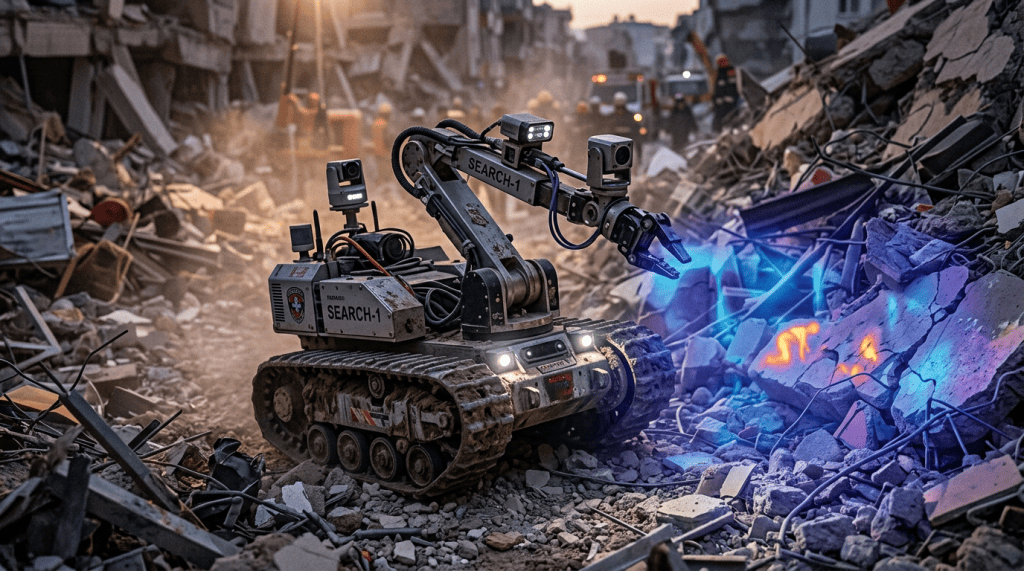
Robotic units can navigate collapsed infrastructure, clear unexploded ordnance, or enter chemical, biological, radiological, or nuclear (CBRN) contamination zones. In these scenarios, replacing human personnel directly saves lives without introducing tactical disadvantages.
2. Asymmetric Warfare and Swarm Tactics
The strategic balance changes when cheap, semi-autonomous units are deployed en masse. Large swarms of low-cost drones or ground units can overwhelm traditional air defense and armor systems, forcing military strategists to completely rethink defense spending and tactical formations.
| Operational Factor | Traditional Human Units | Robotic / Autonomous Units |
| Field Maintenance | Field medical care, rest, food logistics | Component replacement, battery management, software updates |
| Risk Tolerance | High political & human cost | High hardware cost; zero direct casualty cost |
| Operational Fatigue | Physical exhaustion, psychological stress | Limited by power reserves & hardware durability |
| Decision Speed | Bound by human reaction times | Microsecond algorithmic processing |
Practical Lessons and Common Misconceptions
Throughout decades of witnessing technology deployment across various domains, I’ve noticed a recurring pattern: enthusiasm for new capabilities often overshadows operational realities.
       [ Hype / Expectation ]
                  │
                  ▼
┌──────────────────────────────────┐
│   Common Strategic Oversights    │
├──────────────────────────────────┤
│ 1. Ignoring Hardware Logistics   │
│ 2. Overestimating AI Autonomy    │
│ 3. Underestimating Cyber Risks   │
└──────────────────────────────────┘
Key Oversights to Avoid
- Assuming Complete Autonomy Is Ready: Full autonomy in unpredictable, unstructured environments remains an unresolved challenge. Human-in-the-loop systems remain essential for high-stakes decision-making.
- Underestimating Electronic Warfare: A unit that performs flawlessly in a test facility can be rendered useless by aggressive spectrum jamming on the field.
- Focusing Solely on Lethal Applications: The most immediate and high-value applications of robotics are non-lethal: logistics transport, route clearance, casualty evacuation, and real-time surveillance.
Frequently Asked Questions
FAQ
Will robots completely replace human soldiers on the front lines?
No. While robots will increasingly handle high-risk recon, breach points, and hazardous materials, human oversight remains necessary for complex decision-making, adapting to unexpected field changes, and managing strategic communication.
What happens if a military robot loses satellite or network connection?
Most modern designs feature fail-safe protocols that instruct the unit to halt, return to its last known safe coordinate, or switch to a localized defensive mode until communications are restored.
Are there international treaties regulating autonomous weapons?
Discussions are ongoing within forums like the United Nations Convention on Certain Conventional Weapons (CCW). While guidelines exist regarding human control over lethal decisions, comprehensive international treaties targeting fully autonomous weapons are still actively being debated.
Can disaster rescue robots be adapted directly from military designs?
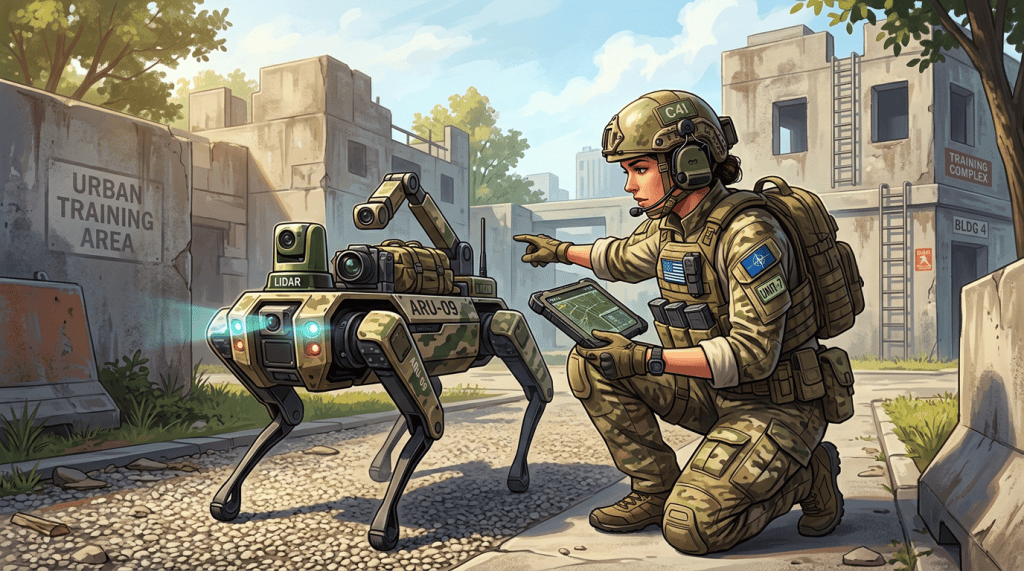
Yes. The core technologies—rugged mobility, thermal sensing, obstacle navigation, and remote tele-operation—are virtually identical. Military investments in durability directly benefit search-and-rescue applications in earthquake zones and industrial sites.
Summary, Key Tips, and Conclusion
Summary
The transition toward military and rescue robotics is an ongoing evolution driven by the desire to minimize human casualties. While these systems offer major strategic advantages in high-risk environments, they bring serious ethical concerns regarding accountability, significant cyber vulnerabilities, and complex maintenance logistics. Addressing these challenges requires clear operational frameworks and international consensus before full-scale integration.
Key Tips
- Maintain Human Oversight: Keep human operators in the loop for critical decision-making processes.
- Prioritize Cyber Resilience: Secure radio links, sensor pipelines, and firmware updates against spectrum jamming and electronic warfare.
- Focus First on High-Utility, Non-Lethal Roles: Leverage robotics for rescue, logistics, bomb disposal, and intelligence gathering where the benefits are immediate and ethically sound.
- Establish International Standards: Develop clear legal frameworks regarding algorithmic accountability and rules of engagement before deploying autonomous hardware.Defense Strategy
Conclusion
Technology itself is neutral; its impact depends entirely on how we choose to govern and deploy it. As robotics and artificial intelligence become integral to security and emergency response, our primary focus must remain on ethical clarity, legal accountability, and robust engineering. Replacing human bodies with machines on the front line solves one problem, but it demands that we exercise even greater wisdom in managing the systems we create.
Metadata & Internal Links
- SEO Title: Military & Rescue Robotics: Ethics, Strategy, and Future Impact
- Meta Description: An in-depth analysis of autonomous robots in military and rescue operations. Explore the ethical dilemmas, technical risks, and strategic shifts of battlefield automation.
- URL Slug: military-rescue-robotics-ethics-strategy
- Primary Keyword: military robotics ethics
- Secondary Keywords: autonomous defense systems, battlefield automation, search and rescue robots, military AI strategy
- Featured Image Prompt: A striking side-profile portrait of a futuristic ground rescue robot operating during a dusk training exercise, set against a subtle, muted horizon with soft warm lighting reflecting off its titanium housing. Professional photography, sharp focus, 8k resolution.
- Image Alt Text: Advanced autonomous military and rescue robot on field terrain during sunset operations.
- Internal Linking Suggestions:
- Link to an internal post discussing Artificial Intelligence Ethics and Governance.
- Link to a guide on Cybersecurity Strategies for IoT and Hardware Integration.
- Link to an article on The Future of Human-AI Collaboration in High-Risk Industries.
It’s never too late to learn, grow, and discover new possibilities.
Explore the books of Han Jong-Woo, where artificial intelligence, lifelong learning, personal growth, and meaningful living come together to inspire your next chapter.
Whether you’re curious about AI, seeking purpose, or simply looking for fresh inspiration, you’ll find books designed to encourage, empower, and enrich your life.
▶ Visit Han Jong-Woo’s Amazon Auhttps://www.amazon.com/s?i=digital-text&rh=p_27%3AJongWoo%2BHan&s=relevancerank&text=JongWoo+Han&ref=dp_byline_sr_ebooks_1thor Page and discover all of his books today.
 Summit Select
Leave a comment