
Time travel transcends the boundaries of movies and novels, entering the realm of science and philosophy, where it ignites profound discussions. Among these, the grandfather paradox serves as a crucial thought experiment, examining the implications of time travel. In this article, we will delve into the grandfather paradox, exploring the intricate questions it raises about time, existence, and causality.
1. The Grandfather Paradox: Overview and Definition
The grandfather paradox describes a logical contradiction that occurs when a time traveler goes back and prevents their grandfather from meeting their future spouse. This scenario challenges our traditional understanding of time flow and causal relationships, raising fundamental questions about existence itself.
Understanding Through an Example Consider a time traveler, let’s call them A, who travels back to the 1960s and prevents their grandfather from meeting his future spouse. If A’s grandfather never falls in love or marries, A’s parents would never be born, and consequently, A would not exist. However, if A does not exist, then how could they have traveled back in time in the first place? This scenario underscores the complexities of time and causality.

2. Scientific Context: The Possibility of Time Travel
The concept of time travel is intricately linked to Einstein’s theory of relativity, which posits that time is the fourth dimension of the universe and can bend similar to space. Theoretically, under certain conditions, it might be possible to travel backward or forward in time.
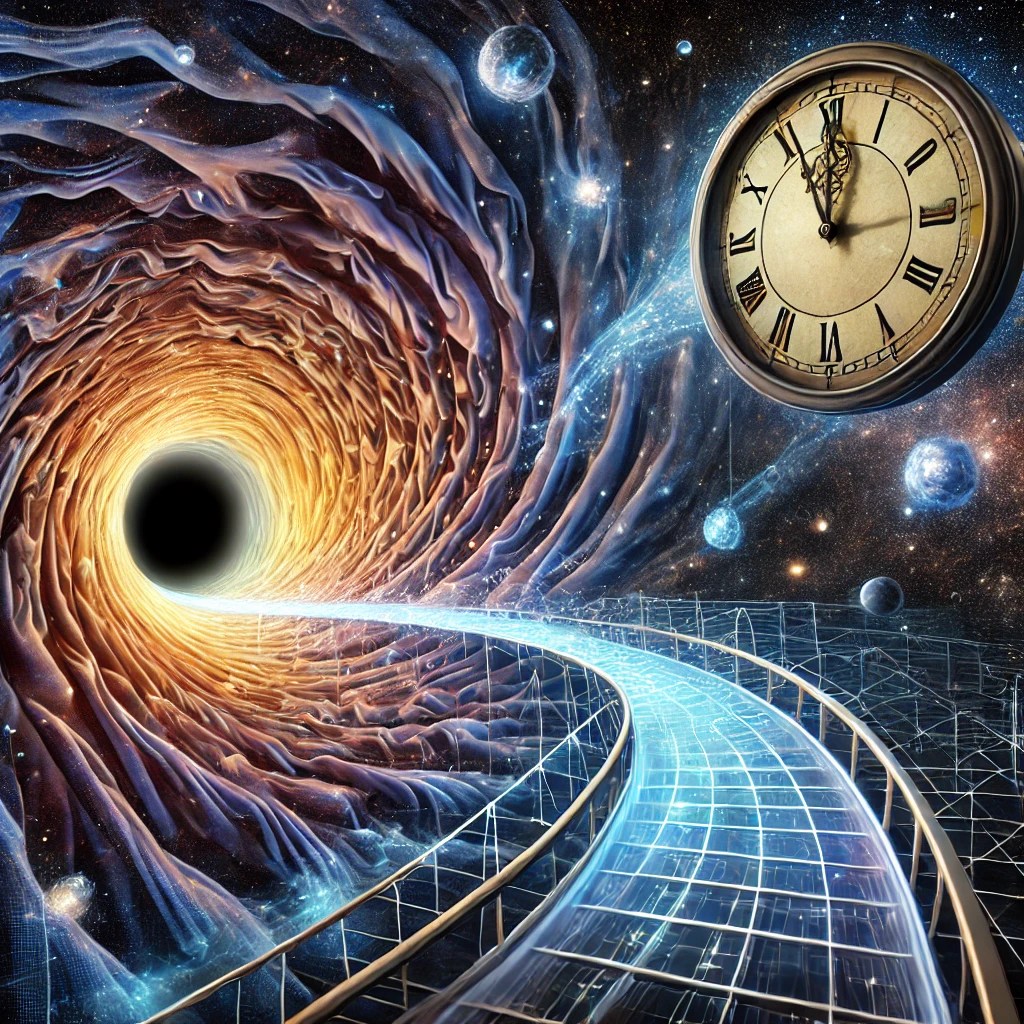
Here is an illustration that conceptually represents Einstein’s theory of relativity and time travel. The view of space-time bending around a black hole and the clock face representing time are combined with the cosmic background to symbolically represent the bending of time. Also included are corridors or tunnels that express theoretical possibilities of going back or forward in time.
The Bending of Time Einstein’s theory suggests that near extreme celestial bodies like black holes, time may flow more slowly, or there might even be pathways that allow for travel into the past. However, if such time travel were possible, how would changing past events affect the present? This leads us to deeper explorations of time and causality.
Lack of Scientific Evidence Currently, there is no experimental evidence to support time travel. While theoretical research is ongoing, scientists are exploring various approaches to address these questions. The absence of empirical evidence indicates that time travel remains largely theoretical, requiring critical evaluation and vigilant monitoring of scientific progress.
3. Philosophical Considerations: Causality and Free Will
The grandfather paradox also triggers significant philosophical discussions. If a time traveler were to prevent their grandfather from meeting their future spouse, thus negating their own existence, how could the time traveler have returned to the past? This inquiry challenges our understanding of causality and free will.
The Complexity of Causality Causality, the principle that explains the relationship between cause and effect, faces contradictions in the context of the grandfather paradox. If a time traveler intervenes in their past, the result could negate their own existence. Under such circumstances, can we truly assert the existence of free will?

Philosophical Discussions The philosopher David Hume offered a skeptical view of causality, suggesting that it is merely a habit formed by experience. His discussions provide valuable insights into understanding the complexities involved in the grandfather paradox and our perception of time and existence.
4. The Parallel Universe Theory: A New Solution to the Paradox
Some theorists propose that the grandfather paradox can be resolved through the concept of parallel universes. According to this theory, each time a time traveler alters the past, a new universe is created. This allows the time traveler to exist in a different timeline from the original universe, maintaining the original timeline intact and avoiding contradictions.
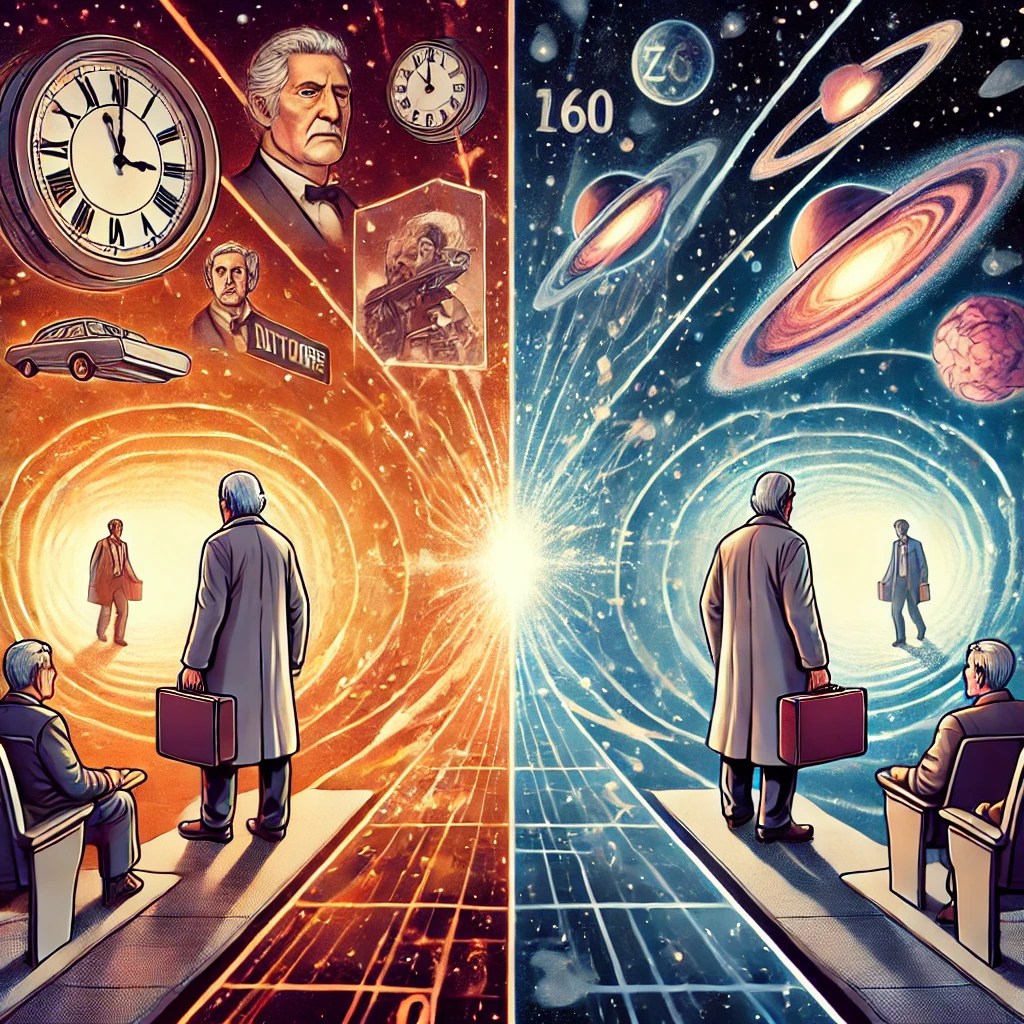
Here is an illustration on the theme of time travel related to the concept of a parallel universe. The image depicts a scene where time traveler ‘A’ creates a new universe in the 1960s by preventing his grandfather from seeing his future spouse. In one universe, ‘A’ does not exist because his grandfather cannot meet his spouse, while in the other original universe, ‘A’ continues to exist. It is expressed using divided dimensions or cosmological cracks that represent the separation of the universe..
An Example of Parallel Universes For instance, if A travels back to the 1960s and prevents their grandfather from meeting their future spouse, this act could create a new universe where A may not exist, but in the original universe, A still exists. This perspective offers a potential resolution to the complex issues surrounding time travel.
5. Modern Scientific Approaches: The Grandfather Paradox as an Unresolved Problem
Modern science views the grandfather paradox as an unresolved issue in physics, using it as a tool to expand our understanding of time and the universe. While there is currently no experimental evidence for time travel, theoretical research continues, and future discoveries related to this concept may emerge.
Future Research Directions Scientists are exploring various theoretical models to investigate the possibility of time travel, based on quantum mechanics and relativity. This research could deepen our understanding of time and space and provide insights into the fundamental structure of the universe.

Conclusion: The Future of Time Travel and Philosophical Inquiry
The grandfather paradox raises essential questions about our understanding of time. Through this paradox, scientists and philosophers challenge the fundamental truths of the universe and human existence. What are your thoughts on the possibility of time travel? Do you believe that your existence is determined by past choices? Reflect on these questions and consider how they might expand your understanding of time and existence.
 Summit Select
Leave a comment