
Recent research by MIT scientists has led to a fascinating discovery concerning Mars and dark matter. According to their studies, primordial black holes, which might be a component of dark matter, could pass through our solar system and slightly alter the orbit of Mars. This change, manifesting as a minor wobble in Mars’s orbit, is detectable with today’s high-precision space technology.
Theoretically, as these primordial black holes traverse the solar system, their proximity to Mars could influence its orbital path. If such orbital variations were observed, it would provide crucial clues about the nature and characteristics of dark matter. The researchers employed complex simulations to predict how Mars might react to these black hole paths.
This research could be a significant step in uncovering the nature of dark matter, which comprises a large portion of the universe yet remains largely mysterious. If this theory is validated, it could enhance our understanding of one of the most enigmatic aspects of the cosmos.
For more detailed information, you can visit MIT News. This article could greatly aid in deepening our understanding of dark matter, stimulating academic curiosity.
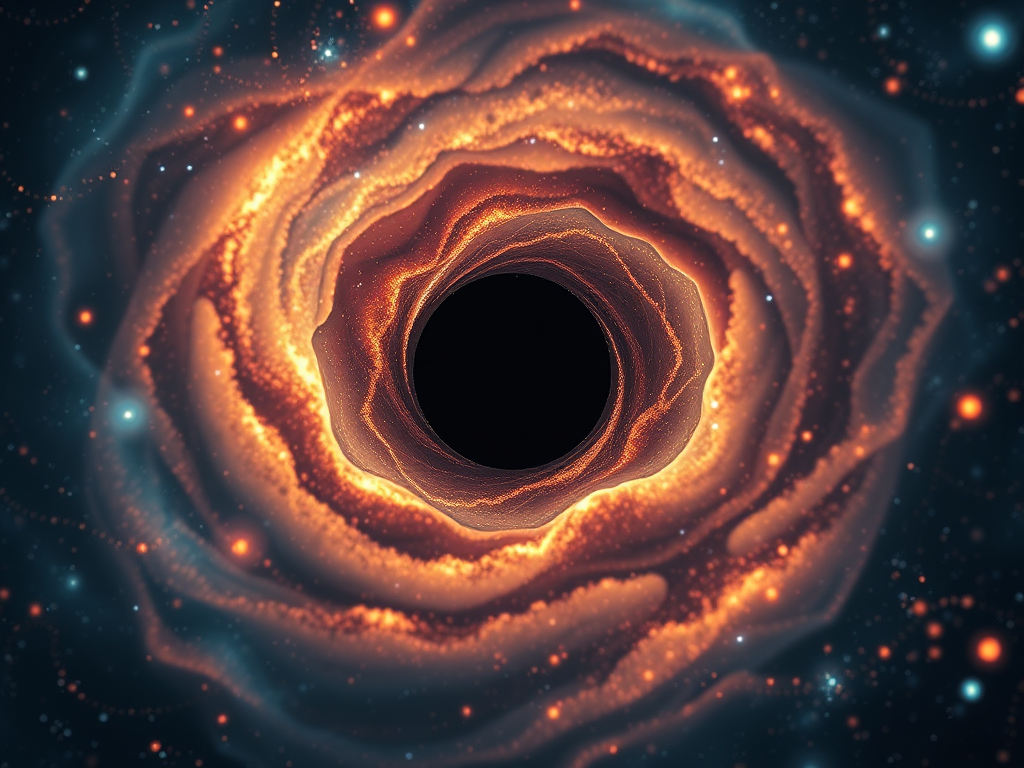
Adding to this intriguing study, the investigation of primordial black holes extends beyond mere scientific discovery, potentially revolutionizing our understanding of the cosmos.
New Chapter in Space Exploration: The existence and impact of primordial black holes could significantly influence how we conduct space exploration. If similar phenomena are observable on other planets, it could advance our understanding not just of dark matter but also of fundamental cosmic laws.
Advancement of Cutting-Edge Technology: The advanced space technology and powerful computer simulation tools used in this research could be applied in other scientific fields. For example, they could be invaluable in researching climate change or predicting geological phenomena on Earth.
Increased Public Interest and Education: Such research can heighten public interest in science, particularly inspiring the younger generation to pursue careers in science and engineering. It could spark curiosity among students to explore the mysteries of the universe.
This type of scientific research offers more than just discoveries—it answers fundamental questions about our world and the universe, expanding human knowledge beyond mere scientific curiosity to play a vital role in broadening human understanding.
 Summit Select
Leave a comment